FITBODY Training · Core and Abs
Ab Workouts for Women: The 8 Best Ab and Core Exercises
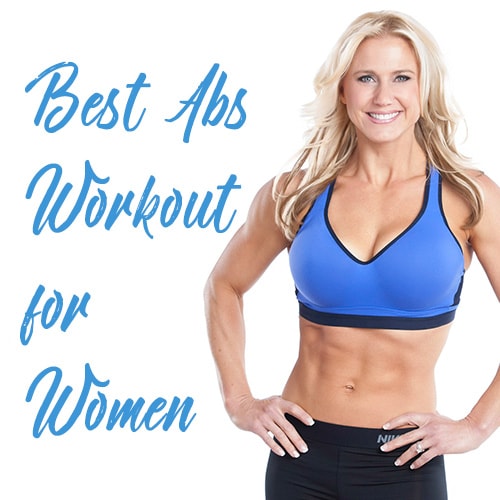
A complete ab workout for women you can finish in about fifteen minutes, built from the eight core exercises I use most with my own clients, with the reps, the form cues and the modifications that keep it working well past 40.
What Is the Best Ab Workout for Women?
Finding an ab workout that actually defines and chisels your core can be a challenge. Most of what gets published is a random pile of crunches with no logic behind it, and most women I talk to have been doing some version of that for years without much to show for it. After more than twenty years of coaching women and building my own core on and off a magazine cover, I can tell you the workout matters far less than most people think, and the structure matters far more.
The best ab workout for women is a short circuit of four to six exercises that trains the core in all of its jobs, flexion, rotation, lateral bending and resisting movement, performed two to three nonconsecutive days a week alongside full body strength training. The circuit below uses eight exercises, takes about fifteen minutes, and is scaled so a beginner and an advanced lifter can run the same session at different levels.
Ab exercises build the muscle. They do not remove the fat covering it. In a controlled trial, six weeks of abdominal training five days a week produced no change in body fat percentage, abdominal circumference or abdominal skinfold measurements compared to a control group (Vispute et al.). Definition comes from body composition. The workout builds what shows up once your body fat drops.
So train your core the way you would train any other muscle group, with real load, real progression and real recovery, and let your nutrition and full body training handle the rest. That is exactly how I build it inside my FITBODY Recomposition System™, and it is why my clients see their midsection change while the scale often barely moves.
What the Core Actually Does
Your core is not one muscle. It is a group of them working together to control your trunk, and each one needs a different kind of exercise to get stronger.
- Rectus abdominis. The front sheet of muscle, the part people mean when they say abs. It flexes your spine, which is what a sit-up or a crunch trains.
- Obliques. Internal and external, running along your sides. They handle rotation and side bending, and they are the muscles that give a waist its shape.
- Transverse abdominis. The deep layer that wraps your midsection like a corset. It does not move your spine, it braces it, which is why planks and anti-movement work matter so much.
- Spinal erectors and the lumbopelvic hip complex. The back half of the cylinder. Ignore it and you get a strong front, a weak back and a cranky lower spine.
Research on core training draws a clear line between core stability, the ability to hold position under load, and core strength, the ability to produce force, and notes that the two respond to different training and should both be included (Hibbs et al.). That is why the circuit below is not eight variations of a crunch. It has holds, it has flexion, it has rotation, and it has anti-rotation.
The Ab Workout at a Glance
Complete each exercise as a circuit, moving down the list with no rest between movements. Once you finish one set of every exercise, rest for one minute. Run the circuit three to four times depending on your level, on three nonconsecutive days a week, in addition to your regular strength training.
| Exercise | Reps or time | Primary target | Level |
|---|---|---|---|
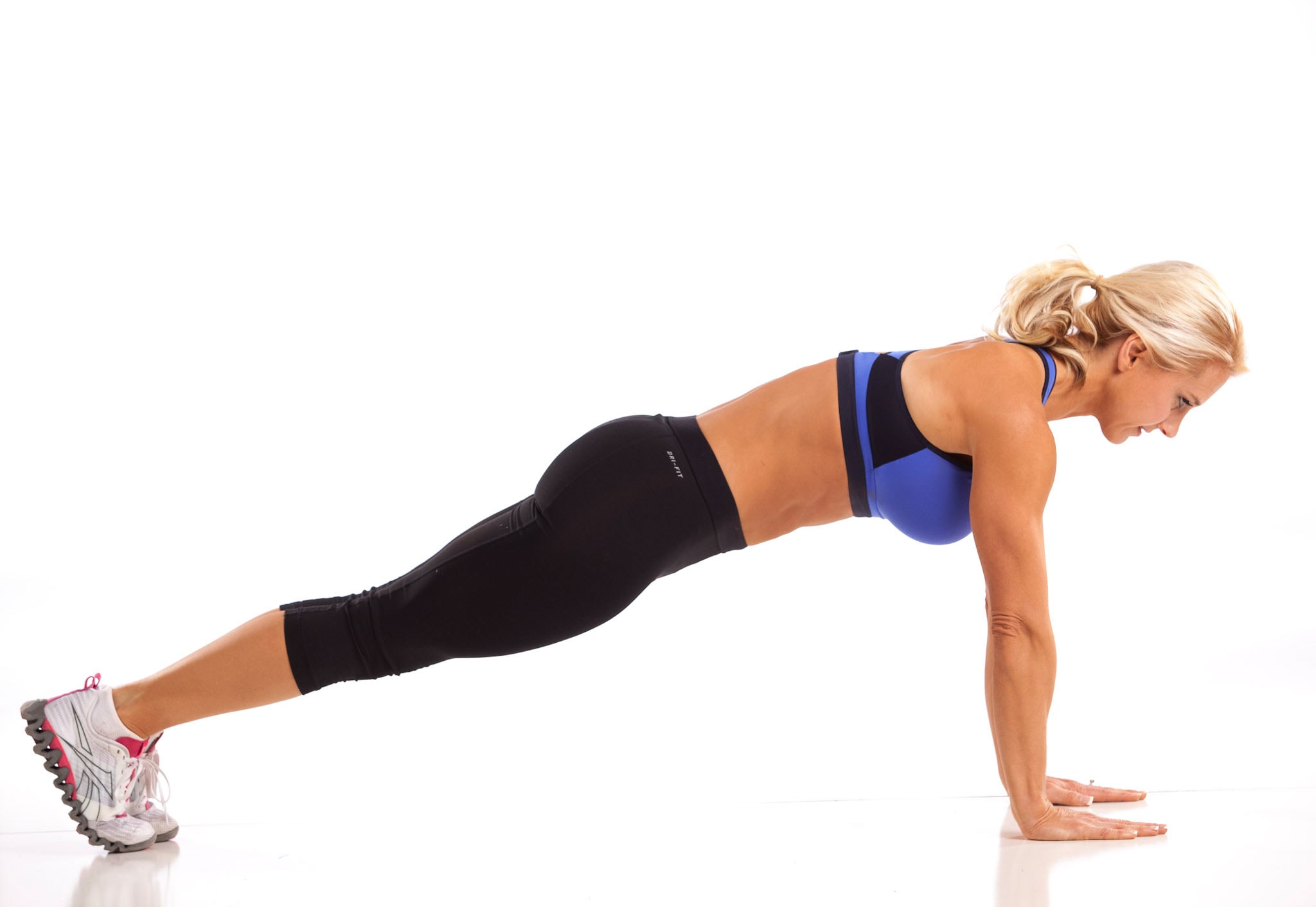
| Plank | 30 to 60 seconds | Transverse abdominis, anti-extension | Beginner |
| Bird Dog | 8 each side | Anti-rotation, spinal erectors | Beginner |
| Reverse Crunch | 12 to 15 | Lower rectus abdominis | Beginner |
| Toe Taps | 10 each side | Lower abs, pelvic control | Beginner |
| Side Plank Pulses | 20 each side | Obliques, lateral chain | Intermediate |
| Butterfly Sit-ups | 20 | Rectus abdominis | Intermediate |
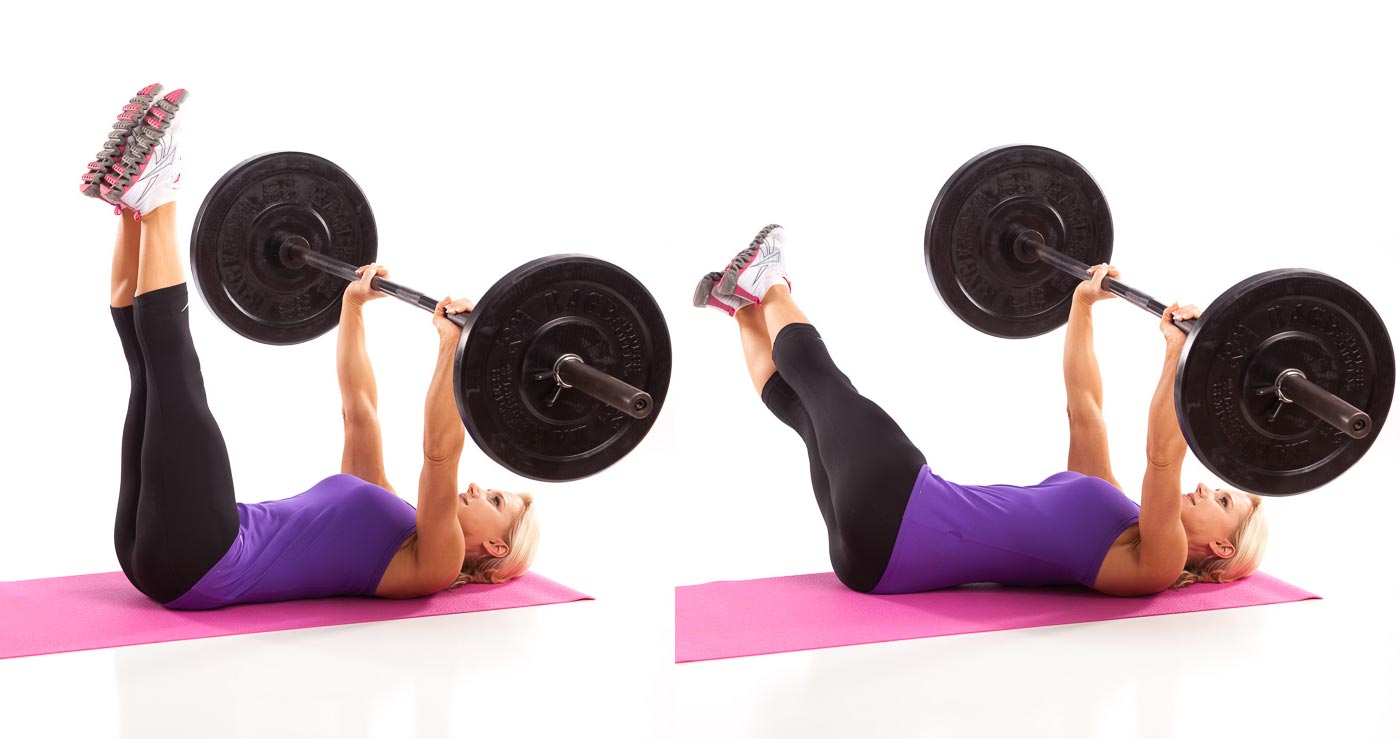
| Barbell Wipers | 10 each side | Obliques, rotational control | Advanced |
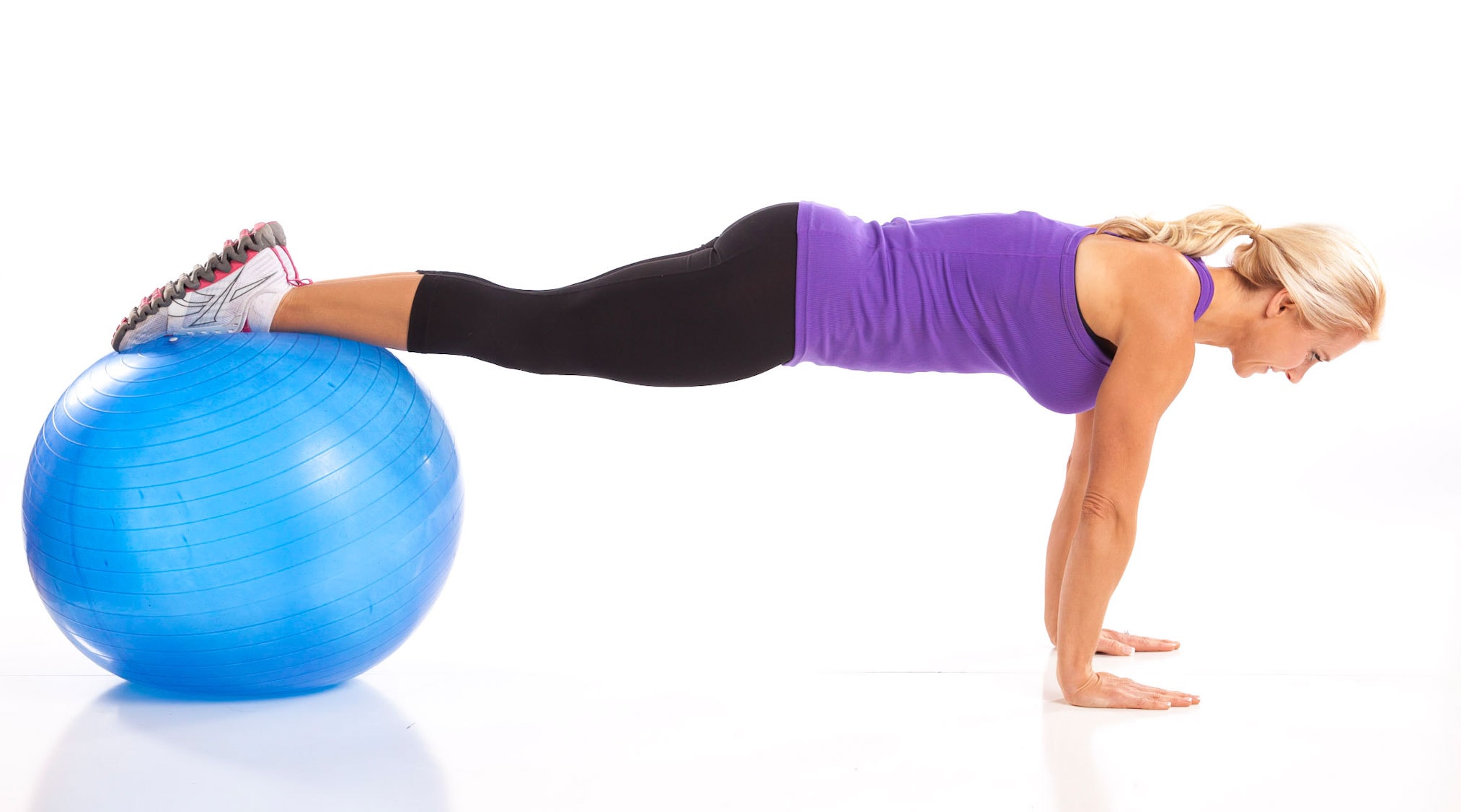
| Ball Pike Ups | 10 | Full core, shoulders | Advanced |
If you are newer to core work, run the first four only and build to three full rounds before you add anything else. If you are advanced, run all eight. This is the workout I have always called Julie Lohre’s Killer Abs, and it earns the name.
The 8 Best Ab and Core Exercises for Women
Every one of these has a full demonstration page in my exercise library if you want to see the movement broken down further.
Plank
The plank might be the simplest exercise on this list, but performed correctly it is a powerhouse for core engagement. Your body should form a straight line from your shoulders to your ankles. Brace your abs the way you would if someone were about to punch you in the gut, drawing your belly button inward and keeping your stomach tight.
Work toward holding for 60 seconds. If you cannot get there yet, hold for 5 to 10 seconds, rest for 5, and repeat for one minute. As your core gets stronger the hold gets easier, and that is the progression.
Focus on form. Do not drop your hips or raise your butt. Planks look deceptively simple, but done properly they do more for your deep core than sit-ups ever will.
Bird Dog
Start on all fours with your hands under your shoulders and knees under your hips. Brace your midsection, then extend your right arm forward and your left leg back until both are level with your torso. Hold for two seconds, return with control, and switch sides.
This is the exercise that trains the back half of your core, the part almost every ab routine skips. It is also one of the safest ways to load the spine, which makes it a staple for anyone with a history of low back trouble.
Balance a light object on your lower back and keep it there. The second your hips rotate, it falls. That feedback teaches anti-rotation faster than any cue I can give you.
Reverse Crunch
Lie flat with your arms at your sides and your knees bent at about 90 degrees. Press your lower back into the floor, then use your abs to curl your hips up off the ground, drawing your knees toward your chest. Lower slowly. The range of motion is small and that is intentional.
If you have spent years doing crunches and still feel nothing in your lower abs, this is the exercise that fixes it. The movement comes from the pelvis, not the shoulders.
If you feel this in your hip flexors instead of your abs, you are swinging your legs. Slow the lowering phase down to three full seconds and cut the reps in half.
Toe Taps
Lie on your back with your knees bent and lifted so your shins are parallel to the floor, a position often called tabletop. Keeping your lower back pressed down and your core braced, lower one foot until your toes tap the ground, then return to the start and switch sides.
Toe taps look easy and they are not. The whole exercise is a test of whether you can keep your pelvis still while your legs move, which is the exact quality that protects your lower back when you deadlift, squat and carry.
Put one hand under the small of your back. If you feel pressure lift off your hand as the foot lowers, you have gone past your current range. Shorten it.
Side Plank Pulses
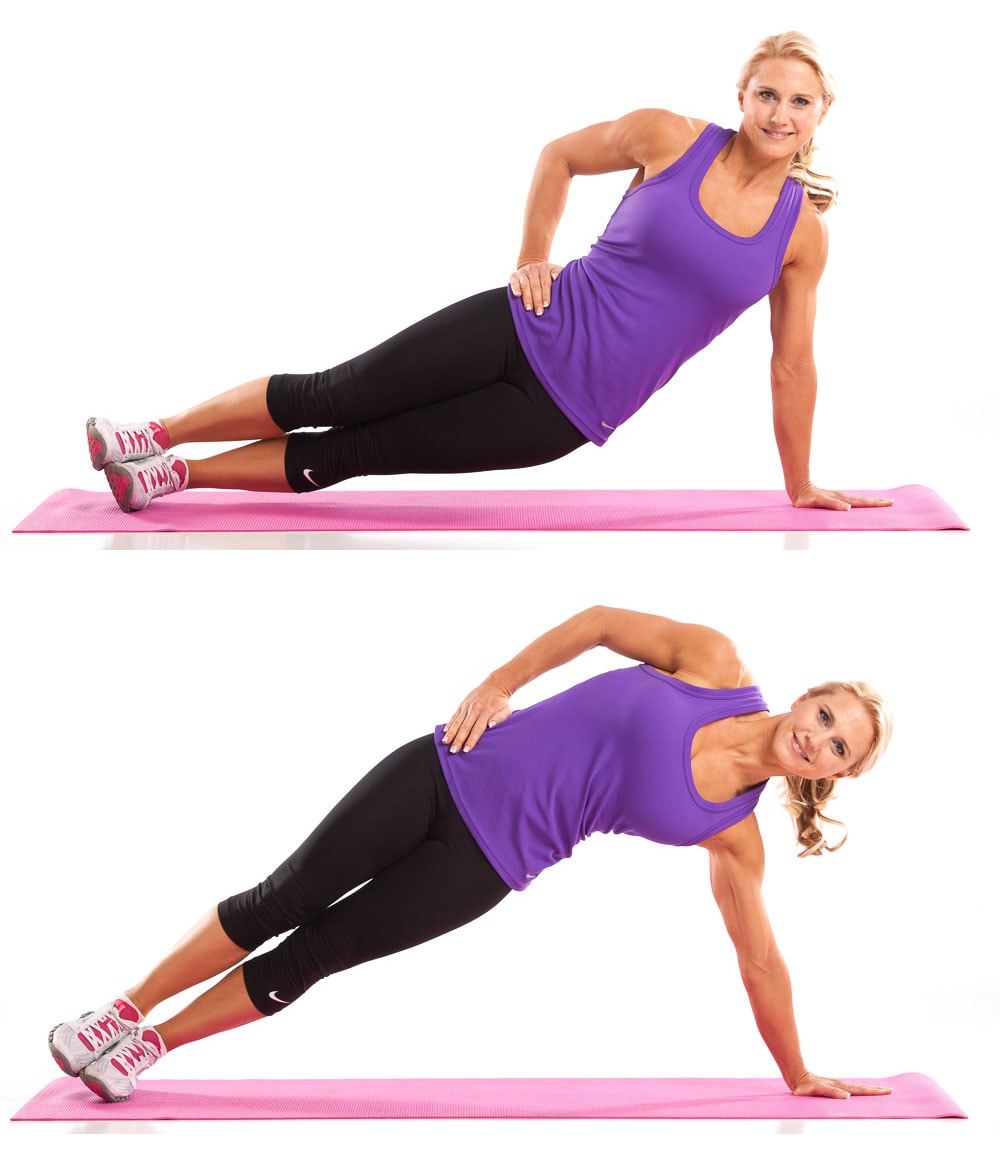
Start in a tight plank with your core contracted, then rotate to one side and balance on one arm with the other hand at your hip. Your body should form a diagonal line from your shoulders to your feet. Keep your midsection braced, then lift up through your top hip as if a string were pulling it toward the ceiling. In a controlled manner, allow your hips to come down just below parallel.
Continue pulsing for 20 reps before you switch sides. Keep your hips and knees off the floor the entire time. Rest 30 seconds between sets.
If you have an elbow or wrist injury, balance on your forearm instead of your palm. That single change makes this workable for most women who otherwise skip side planks entirely.
Butterfly Sit-ups
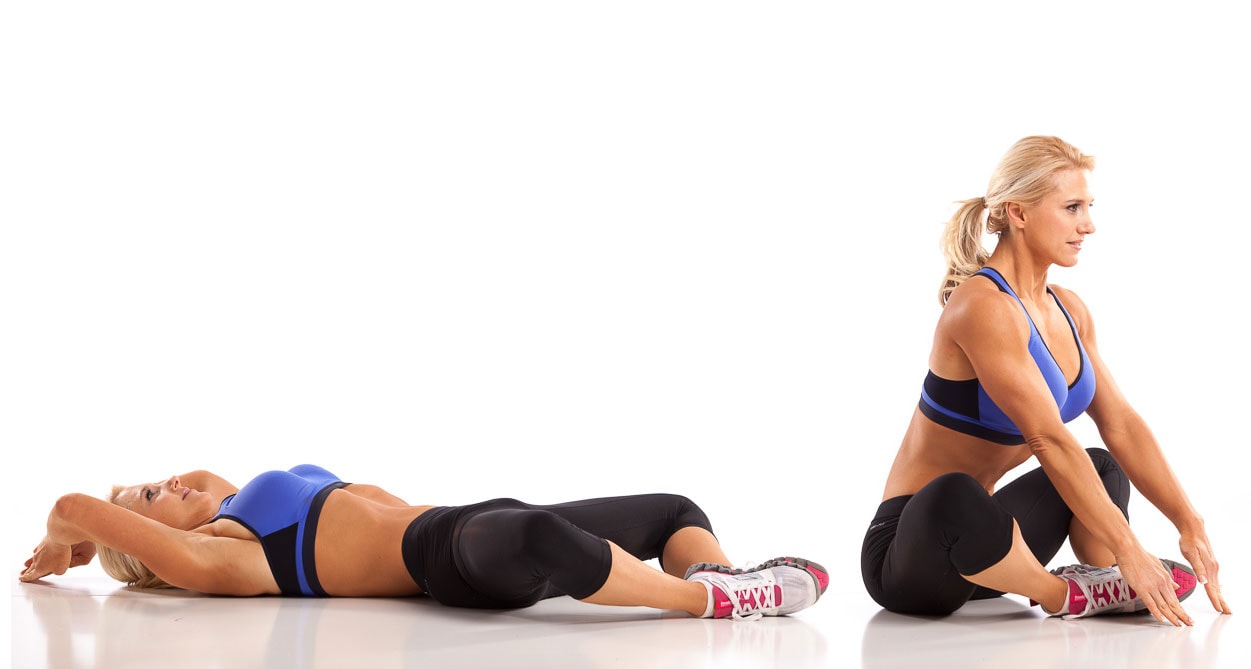
There is a reason CrossFit athletes have some of the best midsections in the gym, and the butterfly sit-up is a big part of it. Lie flat on your back and draw your heels in toward your glutes so your legs form a diamond. Extend your arms overhead to touch the ground behind you, then use your abs to come up and over and touch your hands to the floor in front of your feet.
Because your feet are not anchored and your knees are open, your hip flexors cannot take over the way they do in a standard sit-up. Your abs have to do the work.
Speed is where this goes wrong. When women rush these, the lower back arches off the floor and momentum carries them up. Keep your lower back pressed down and sit up in a controlled manner, even if it costs you reps.
Barbell Wipers
One of my all time favorites. Barbell wipers hammer the obliques you use to bring your legs back up. Lie flat on the floor with a barbell, either the bare bar or loaded to your choosing, and press it overhead. Maintain that locked out position with your upper body and extend your legs up over your hips.
In a controlled manner, let your legs fall to one side, only as low as you can still control the movement. Contract your obliques to lift your legs back to the start, then repeat to the opposite side, forming a windshield wiper motion. Complete 10 each side.
Do not do these on a weight bench. It is far too easy to roll off. The floor is the right choice. If straight legs are too much, bend your knees and bring your feet closer to your glutes, which shortens the lever and takes the strain off your lower back.
Ball Pike Ups
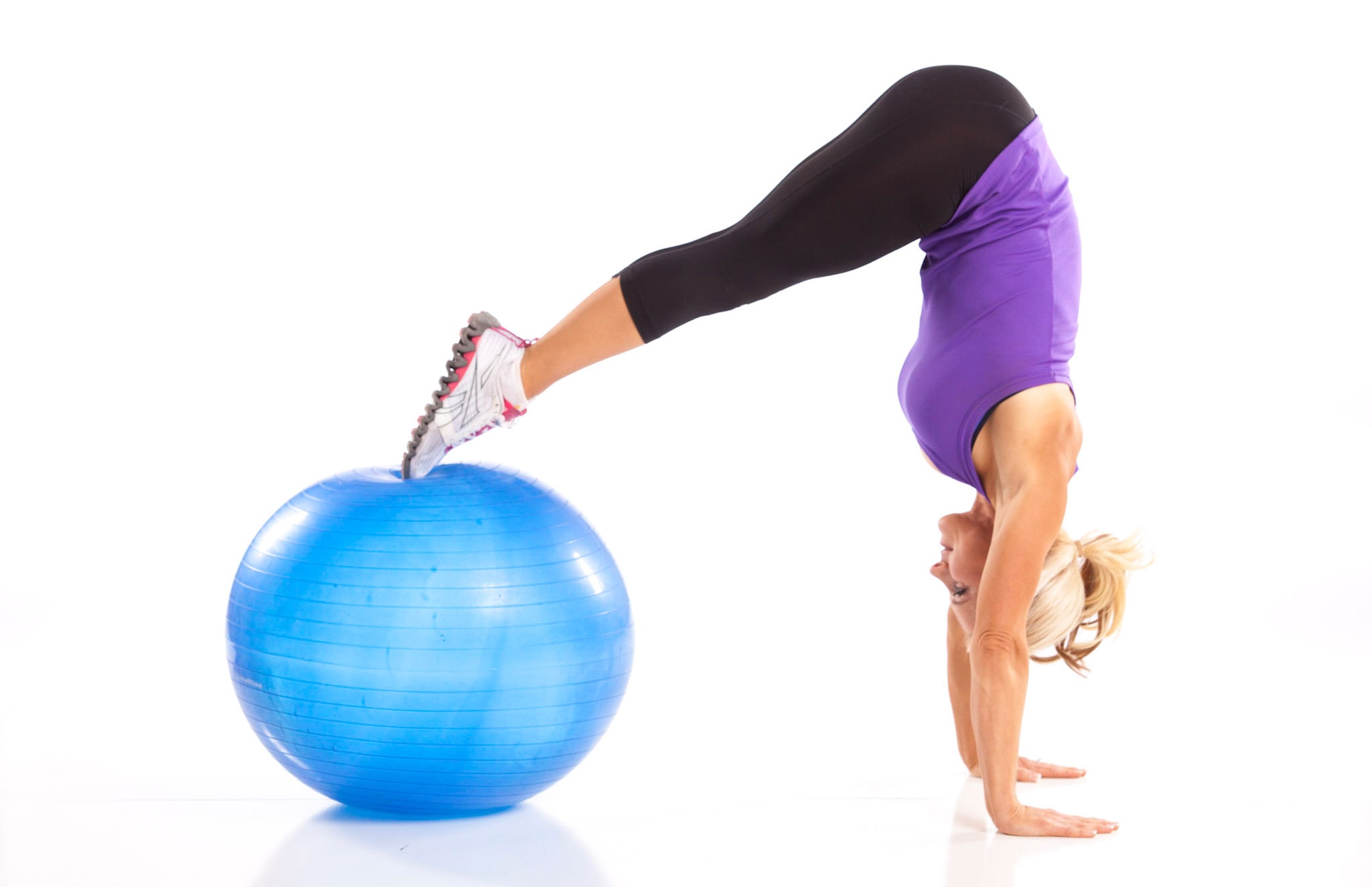
Ball pike ups are an advanced exercise that tests core strength and upper body strength at the same time. Bring a stability ball close to your feet and place one foot on top of it. Walk your hands forward and bring the second foot up so your body reaches an elevated plank position. Keeping your core engaged, draw your legs in and lift your hips as close to overhead as possible. With control, return to the elevated plank. Complete 10 reps.
This is not just an ab exercise. Electromyography research comparing eight stability ball exercises against the traditional crunch and bent knee sit-up found the roll-out and the pike produced the highest core muscle activation of everything tested, while keeping activity in the lower back muscles low (Escamilla et al.). That combination, high abdominal recruitment with low lumbar load, is exactly what you want.
If you are not ready for the full pike, bend your knees and draw them into your chest instead. You still train the core, with far less demand on your shoulders.
Ball curl ins, shown in the video above, are the knee bent version. Curling in rather than piking takes a significant amount of pressure off your shoulders while still loading the core hard. Rest 30 seconds between sets.
See the full ball pike up demonstration or the ball curl in version
How Often Women Should Train Abs
Three nonconsecutive days a week is the sweet spot for most women. Your abs are skeletal muscle like every other muscle group, which means they need a stimulus, then time to recover, then a harder stimulus. Training them daily is why so many women plateau. There is never enough recovery for anything to adapt.
Here is how I sequence it for clients:
- Place core work at the end of a strength session. A fatigued core makes your squats and deadlifts less stable and more risky. Train it after, not before.
- Progress the hold, then the reps, then the load. Go from a 30 second plank to a 60 second plank before you add a weight plate. Go from 10 bodyweight barbell wipers to 10 with a loaded bar.
- Rotate the emphasis. One session heavier on holds and anti-movement, one heavier on flexion, one heavier on rotation. Your core sees all four of its jobs across the week.
- Count your compound lifts. Heavy squats, deadlifts, carries and overhead presses are core work. If your week is already full of those, three short circuits is plenty.
What I do not do is add more core volume when someone is frustrated with how their midsection looks. That is a nutrition conversation, not a training one.
Core Workouts for Women Over 40
Most of the women I coach are over 40, and the honest answer is that the exercises do not need to change nearly as much as people expect. What changes is the entry point, the progression rate, and how much attention recovery gets.
Two things are worth knowing. First, body composition shifts during the menopause transition independently of what the scale says. In the SWAN cohort, fat mass rose and lean mass fell across the transition, with the changes accelerating in the years surrounding the final menstrual period (Greendale et al.). That means a woman can be training hard and eating well and still watch her midsection soften, which is maddening and completely normal. Second, core strength is not just cosmetic at this stage. Core strengthening has been shown to improve balance performance in older adults, which matters more every year (Kahle and Tevald).
The adjustments I actually make:
- Start with the first four. Plank, bird dog, reverse crunch and toe taps. Every one is joint-friendly and every one builds the bracing skill the harder movements require.
- Swap the forearm for the palm. On planks and side planks, drop to your forearm if your wrists complain. Nothing is lost.
- Bend the knees on the loaded work. Barbell wipers with bent knees and a bare bar is a real exercise, not a consolation prize. Shorter lever, less spinal load, same obliques.
- Respect the neck. If butterfly sit-ups aggravate your neck, cross your arms over your chest instead of reaching overhead, or replace them with a second set of reverse crunches.
- Give it four weeks. I run my clients in four week blocks. Week one learn the structure, weeks two and three build, week four push. Then the whole plan changes.
If the deeper reason you want a stronger midsection is that your body composition has changed, that is worth reading about directly. I wrote a full breakdown of how to lose fat and build muscle at the same time, and a separate one on why lower belly fat is so stubborn.
Mistakes That Stall Core Progress
- Chasing volume instead of quality. Two hundred sloppy crunches build less than twenty controlled reps. Every single time.
- Training abs to lose belly fat. The research is unambiguous on this. Core work builds the muscle, a calorie deficit and full body strength training reveal it.
- Never progressing. If you are doing the same plank for the same 30 seconds you did a year ago, your core has no reason to change.
- Skipping the back half. Bird dogs, superman holds and carries balance out all the front-side flexion work. Leave them out and you build an imbalance.
- Letting the lower back arch. On toe taps, reverse crunches and butterfly sit-ups, the moment your lumbar spine lifts off the floor, your abs stop working and your hip flexors take over.
- Holding your breath. Brace and breathe. If you cannot speak a short sentence during a plank, you are gripping, not bracing.
Ab Workout Questions Answered
What is the best ab workout for women?
The best ab workout for women is a circuit of four to six exercises covering flexion, rotation, lateral bending and anti-movement, run two to three nonconsecutive days a week alongside full body strength training. A well built session includes a plank or other hold, a lower ab movement such as a reverse crunch, an oblique movement such as a side plank pulse, and an anti-rotation movement such as a bird dog. Fifteen minutes is enough when the exercises are chosen well and progressed over time.
How often should women do ab workouts?
Two to three nonconsecutive days a week. Abs are skeletal muscle and respond to the same progressive overload principles as your legs or back, which means they need recovery between sessions to adapt. Daily ab training is one of the most common reasons women stop making progress, because the muscle never gets the time it needs to rebuild. If your program already includes heavy squats, deadlifts and loaded carries, the low end of that range is plenty.
Do ab workouts burn belly fat?
No. Ab exercises do not burn belly fat, and no exercise can target fat loss from a specific area. In a randomized trial, participants who performed seven abdominal exercises five days a week for six weeks showed no significant change in body weight, body fat percentage, abdominal circumference or abdominal skinfold measurements compared to a control group (Vispute et al.). Fat loss comes from a sustained calorie deficit combined with full body resistance training. Ab work builds the muscle that becomes visible once body fat drops.
What are the best core exercises for women over 40?
Planks, bird dogs, reverse crunches and toe taps are the best starting core exercises for women over 40 because they build deep bracing strength without loading the spine into end range flexion. From there, side plank pulses and knee bent barbell wipers add rotational and oblique work safely. Core strengthening in older adults has also been shown to improve balance performance (Kahle and Tevald), so the benefit goes well beyond how your midsection looks.
How long does it take to see ab definition?
Most women start to see visible core definition somewhere between twelve and twenty-four weeks, and the timeline depends almost entirely on starting body fat rather than how hard you train abs. Strength improvements show up much faster, usually within three to four weeks, which is why I track plank time and rep quality rather than waiting on the mirror. Photos and measurements taken every two weeks tell the real story long before definition appears.
Should women use weights for ab exercises?
Yes, once bodyweight versions are controlled and comfortable. The core adapts to progressive overload the same way every other muscle does, so adding load is how you keep making progress after the first few months. Practical options include holding a plate on your back during a plank, loading the bar on barbell wipers, or holding a dumbbell across your chest on butterfly sit-ups. Add load only after the movement quality is solid at bodyweight.
Can you train abs every day?
You can, but there is no advantage to it and there is a real cost. Muscle grows during recovery, not during the session, so daily ab training keeps interrupting the adaptation you are trying to create. It also crowds out the training that changes your body composition most, which is heavy compound strength work. Three focused core sessions a week outperform seven rushed ones.
Are ab workouts safe with diastasis recti?
Check with your doctor or a pelvic floor physical therapist before starting any core program if you have diastasis recti, and follow their guidance over anything you read online. In general, deep bracing work such as planks held with a neutral spine, bird dogs and controlled breathing drills is better tolerated than repeated crunching or full sit-ups, which can increase pressure through the abdominal wall. This is one of the situations where an individual assessment matters more than a generic workout.
Want a Core Program Built Around You?
This workout is a great starting point, but the women who see their midsection genuinely change are the ones training and eating to a plan that gets adjusted every two weeks based on their own results. That is what I do inside my FITBODY Lifestyle Coaching® program.
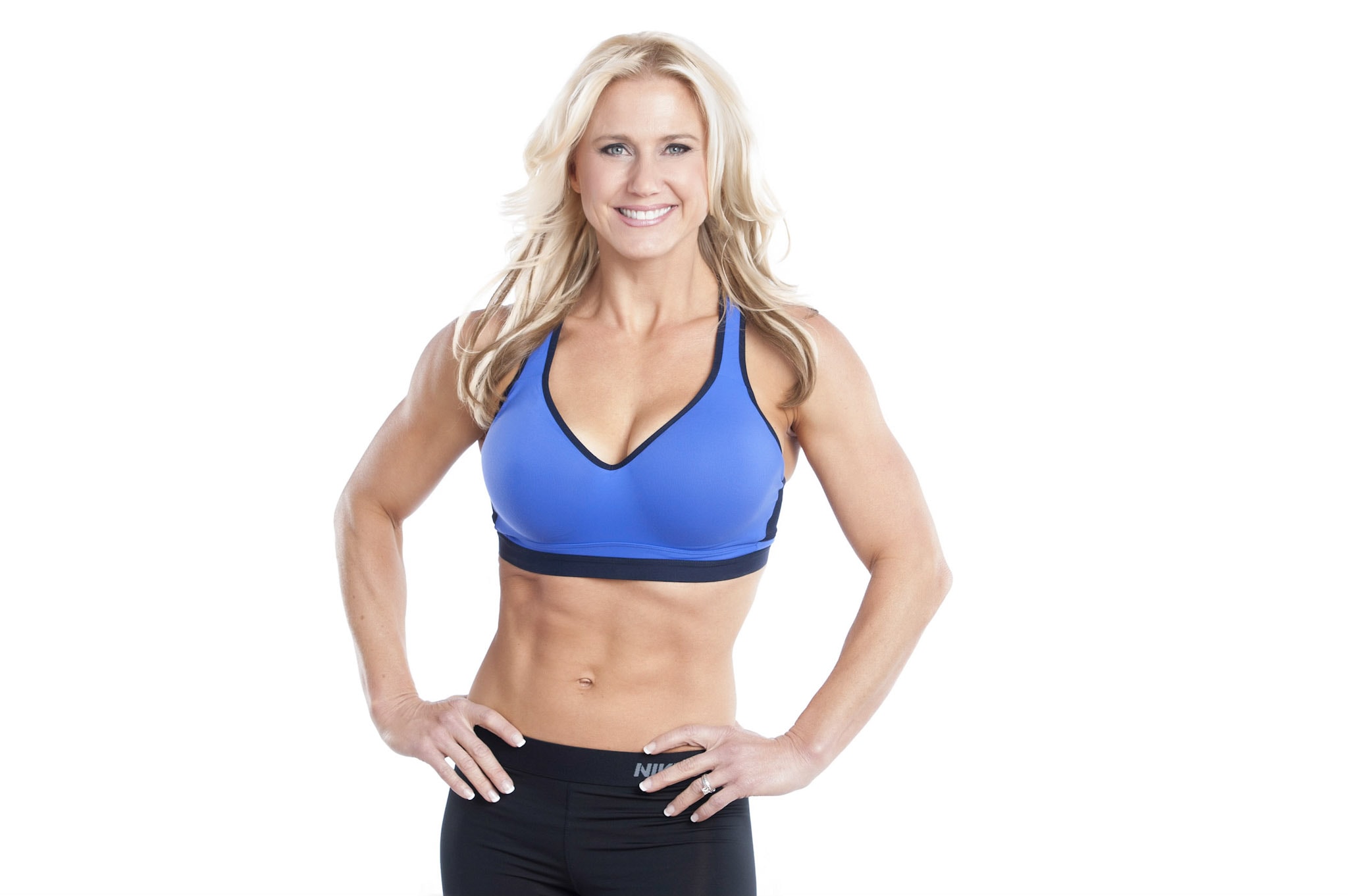
I am Julie Lohre, IFBB Fitness Pro, Certified Personal Trainer, and Certified Nutrition Specialist with 20+ years coaching women. You work directly with me, not an assistant and not an app.
Work With Me One on One See Client ResultsReferences
- Vispute, Sachin S., et al. “The Effect of Abdominal Exercise on Abdominal Fat.” Journal of Strength and Conditioning Research, vol. 25, no. 9, 2011, pp. 2559-2564. PubMed
- Escamilla, Rafael F., et al. “Core Muscle Activation During Swiss Ball and Traditional Abdominal Exercises.” Journal of Orthopaedic and Sports Physical Therapy, vol. 40, no. 5, 2010, pp. 265-276. PubMed
- Hibbs, Angela E., et al. “Optimizing Performance by Improving Core Stability and Core Strength.” Sports Medicine, vol. 38, no. 12, 2008, pp. 995-1008. PubMed
- Kahle, Nicole, and Michael A. Tevald. “Core Muscle Strengthening’s Improvement of Balance Performance in Community-Dwelling Older Adults: A Pilot Study.” Journal of Aging and Physical Activity, vol. 22, no. 1, 2014, pp. 65-73. PubMed
- Greendale, Gail A., et al. “Changes in Body Composition and Weight During the Menopause Transition.” JCI Insight, vol. 4, no. 5, 2019, e124865. PubMed