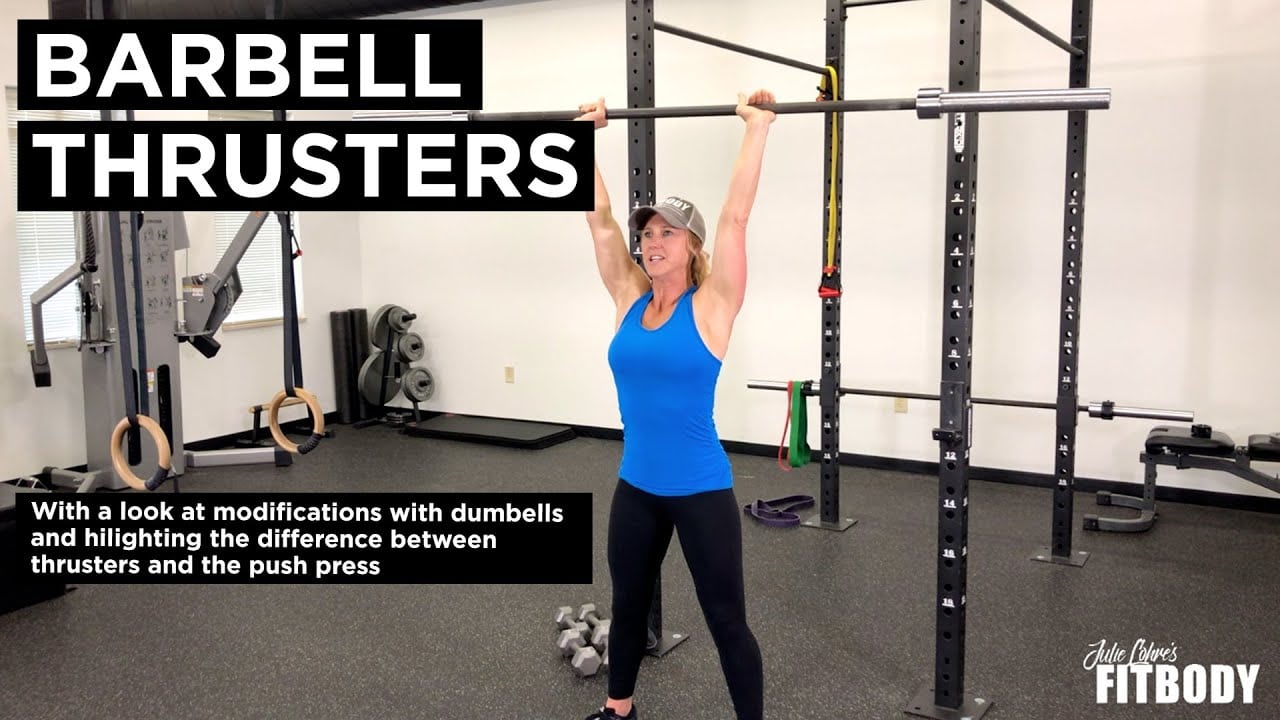
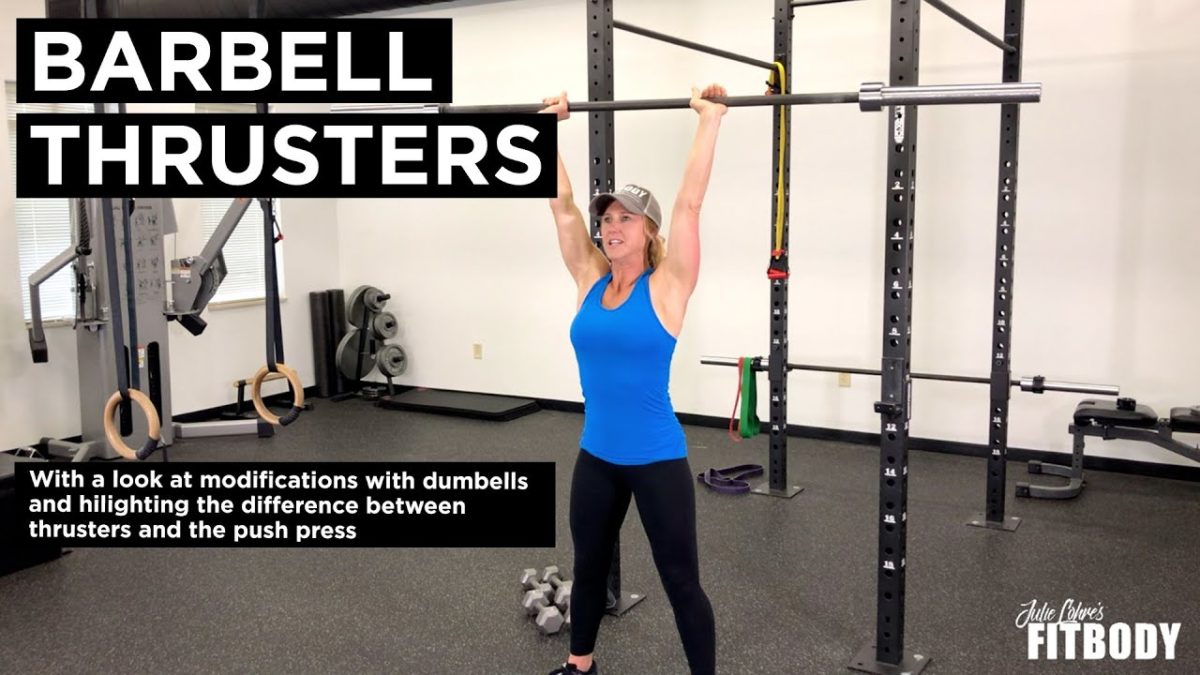
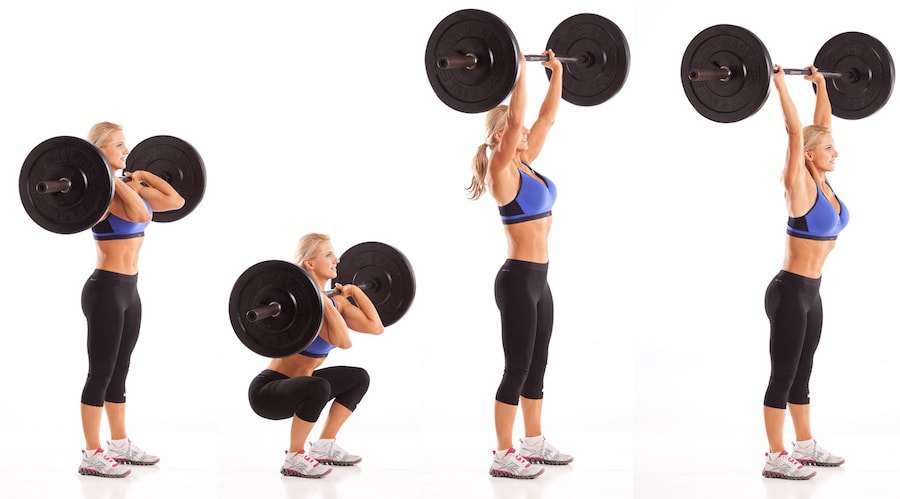
Julie Lohre demonstrating a barbell thruster, driving the barbell overhead out of a front squat

Barbell Thrusters

FITBODY Exercise Library · Full Body

Barbell Thrusters

The barbell thruster combines a front squat and an overhead press into one fluid movement, training the legs, shoulders, and core together for full-body strength and conditioning in a single powerful lift.

Target MusclesQuads, glutes, shoulders
Also WorksCore, triceps, upper back
EquipmentBarbell, rack optional
LevelIntermediate
MovementSquat to overhead press
Watch ForPressing before the legs finish

How to Do a Barbell Thruster

1
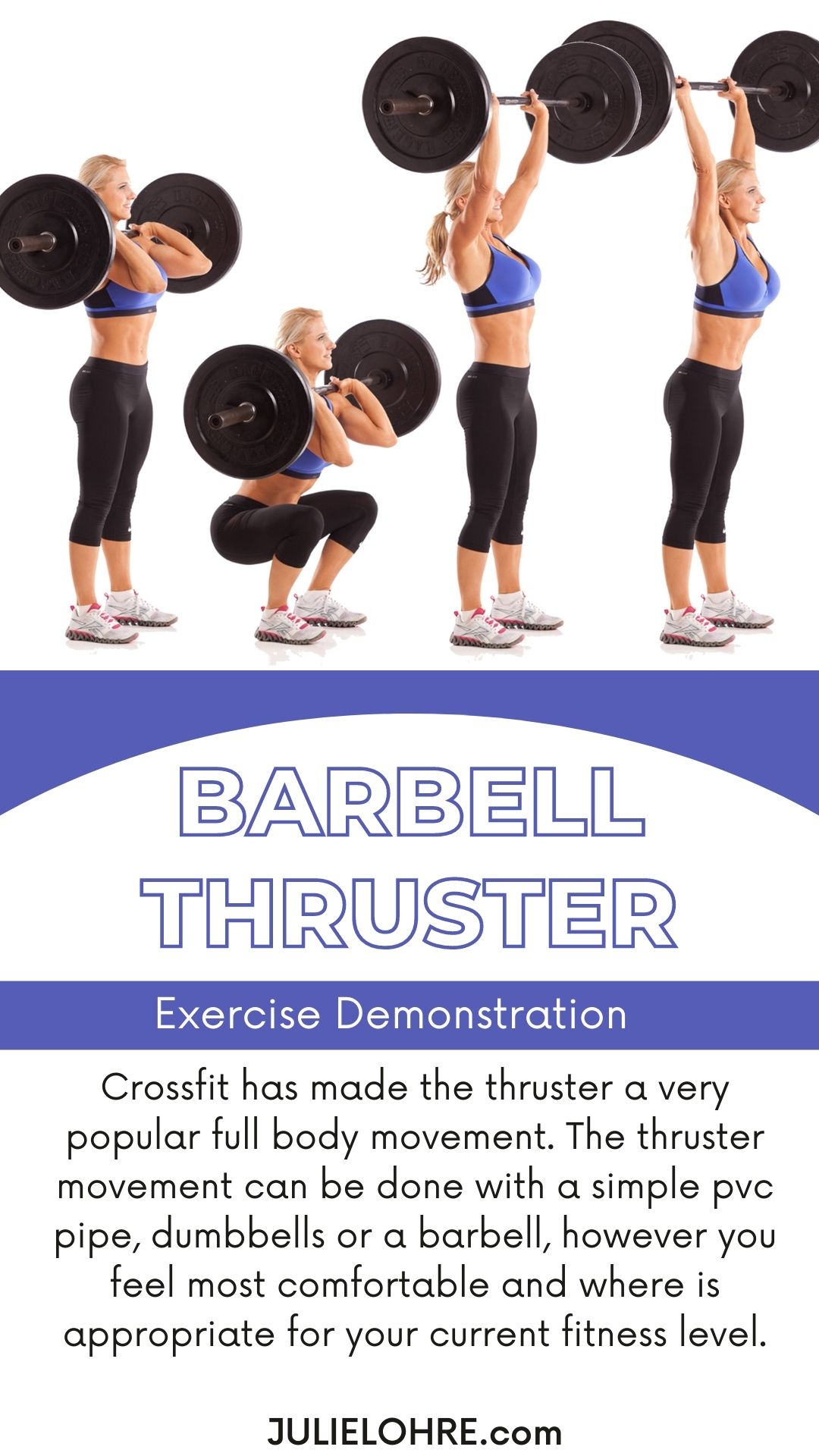
Set the front rack. Hold the barbell across the front of your shoulders in a front rack position, elbows high and pointed forward, hands just outside shoulder-width. Set your feet about shoulder-width apart with toes turned slightly out.
2
Brace and squat. Take a breath, brace your core, and sit down into a front squat. Keep your chest tall and your elbows up, and lower until your thighs reach at least parallel while your heels stay planted.
3
Drive up out of the bottom. Push hard through the whole foot and stand up powerfully. This leg drive is the engine of the whole lift, so be explosive out of the squat.
4
Press overhead. As your hips and knees finish extending, let that momentum carry straight into an overhead press. Push the bar up and slightly back so it finishes stacked over the middle of your feet, arms fully locked out.
5
Return with control. Lower the bar back to the front rack, absorbing it softly with your shoulders as you begin the next squat. Move at a steady rhythm so the squat and press stay connected into one fluid rep.
Julie’s Tip

The thruster is one movement, not two. The power to press the bar overhead comes from your legs, not your shoulders. Time it so the drive out of the squat flows right into the press without a pause. If you squat, stand all the way up, then press as a separate effort, you are working twice as hard for half the result.

Barbell thruster front rack squat position with chest tall and elbows high
Front rack squat, chest tall and elbows high.
Barbell thruster overhead lockout position for women over 40
Overhead lockout, bar stacked over the middle of the feet.

What Muscles Do Barbell Thrusters Work?

The barbell thruster is one of the most complete full-body exercises in the library. The squat portion drives the quads and glutes, the press portion loads the shoulders and triceps, and the core braces hard the entire time to keep you stable under the moving bar. Because it works so much muscle at once, it also raises your heart rate fast, which is why it doubles as conditioning. For the shoulder anatomy behind the press, Physio-pedia has a clear overview of the deltoid. Building full-body strength this way supports the approach in body recomp for women.

Julie Lohre demonstrating a barbell thruster, driving the barbell overhead out of a front squat
Barbell Thruster: drive out of the squat and let that leg power carry the bar straight overhead in one fluid motion.
Primary
QuadricepsGluteus maximusDeltoids
Secondary
TricepsCoreUpper back
See the full muscle breakdown
  • Quadriceps: The front of the thigh. Drive you up out of the front squat and generate the power that carries into the press.
  • Gluteus maximus: Extends the hips as you stand, working with the quads to launch the bar upward.
  • Deltoids: The shoulder muscles that press the bar overhead and lock it out at the top.
  • Triceps: Extend the elbows to finish the overhead press.
  • Core: Braces against the front-loaded bar through the squat and stabilizes the trunk as the weight travels overhead.
  • Upper back: Holds the front rack position and supports the bar path from shoulders to lockout.

Sets and Reps

The barbell thruster is demanding, so keep the reps moderate and the form sharp. Pick a load where the last 2 to 3 reps feel challenging but the bar still moves in one smooth motion. When your squat and press start to disconnect, the set is done.

GoalSetsReps
Strength and shape3 to 48 to 10
Power and conditioning3 to 56 to 8
Beginner or returning2 to 38 to 10
Conditioning circuit3 to 410 to 15

Rest 90 seconds to 2 minutes between strength sets and 45 to 60 seconds in a conditioning circuit. Move at a controlled, rhythmic tempo. Place thrusters early in the session when done for strength, or later as a metabolic finisher.

Variations and Modifications

Dumbbell Thruster

Hold a dumbbell in each hand at your shoulders and perform the same squat-to-press. The dumbbells let your wrists and shoulders move more naturally, and they are far more home-friendly than a barbell. This is where most women should start before loading a barbell thruster.

Barbell thrusters and dumbbell thrusters demonstration by Julie Lohre
Barbell and dumbbell thrusters both build full-body strength. Start with dumbbells to groove the pattern.

Kettlebell Thruster

Use one or two kettlebells in the front rack. The offset load challenges your core and shoulders a little differently and is a great option when a barbell is not available.

Front Squat and Push Press (Broken Down)

If the full thruster feels like too much at once, practice the two halves separately. Build your front squat first, then your push press, and combine them once each piece feels solid. My barbell front squat guide walks through the squat portion in detail.

The barbell thruster pairs well with rows, pull-ups, and carries in a full-body or conditioning day, and it supports the strength approach in progressive overload for women.

Common Mistakes to Avoid

  • Separating the squat and the press. Standing all the way up before pressing turns one efficient lift into two hard ones. Let the drive out of the squat flow straight into the press.
  • Letting the elbows drop in the squat. If the elbows fall, the bar rolls forward and your chest caves. Keep the elbows high through the bottom of every rep.
  • Pressing the bar out in front. Push the bar up and slightly back so it locks out over the middle of your feet, not out ahead of you where your lower back has to compensate.
  • Going too heavy too soon. The thruster is only as strong as its weakest link, usually the overhead press. Load for the press you can control, not the squat you can crush.

Barbell Thruster FAQs

What do barbell thrusters work?

Barbell thrusters work almost the entire body in one movement. The squat portion builds the quads and glutes, the press portion builds the shoulders and triceps, and the core stays braced the whole time to stabilize the bar. Because so much muscle is working at once, thrusters also spike your heart rate and deliver a strong conditioning effect. That combination of strength and cardio in one lift is exactly why I program them for women who want efficient, full-body training.

What is the difference between a thruster and a push press?

A push press starts from a shallow dip and drive, just enough leg bend to help launch the bar overhead. A thruster starts from a full front squat, so you are combining a complete lower body lift with the overhead press. The thruster works far more muscle and demands more conditioning, while the push press lets you move heavier weight overhead because the legs only assist. Think of the push press as the overhead half and the thruster as the full-body version.

Can I do thrusters at home without a barbell?

Absolutely. Dumbbell thrusters are an excellent substitute and are often a better starting point than the barbell version. Hold a dumbbell in each hand at your shoulders and perform the same squat-to-overhead-press. A pair of kettlebells works too. The dumbbells also let your wrists and shoulders move more naturally, which many women find more comfortable overhead.

Are barbell thrusters good for women over 40?

Yes, when the form and load are right. Thrusters build lower body and shoulder strength, train coordination and core stability, and deliver a conditioning effect all in one efficient movement, which matters more as time gets tighter and recovery gets more precious. Start with dumbbells to groove the pattern, keep the weight in a range you can control cleanly overhead, and never let the squat and press disconnect. Pair them with a smart strength-focused program like my FITBODY Lifestyle Coaching for the best results.

How much weight should I use for thrusters?

Load for your overhead press, not your squat, because the press is the limiting part of the lift. Start light enough that the bar moves in one smooth motion for every rep, then add weight in small jumps once the pattern is solid. Stop each set with 1 to 2 clean reps still in the tank. If the bar stalls overhead or the squat and press break apart, the weight is too heavy.

References

  1. Physio-pedia. “Deltoid Muscle: Anatomy and Function.” https://www.physio-pedia.com/Deltoid.
  2. Physio-pedia. “Quadriceps Muscle: Anatomy and Function.” https://www.physio-pedia.com/Quadriceps_Muscle.
Barbell thruster exercise guide for women, save to Pinterest
Save this barbell thruster guide to Pinterest.

Train With An Expert

Want a Plan Built Around You?

I’m Julie Lohre, an IFBB Fitness Pro and certified personal trainer and nutrition specialist. For more than 20 years I have helped women over 40 get stronger, leaner, and more confident through personalized online coaching built around their real lives.