
FITBODY Exercise Library · FULL BODY
Dead Curl Press
The dead curl press combines a dumbbell deadlift, biceps curl, and overhead shoulder press into one continuous full-body exercise. It trains the lower body, arms, and shoulders while challenging coordination and trunk control.
What Is the Dead Curl Press?
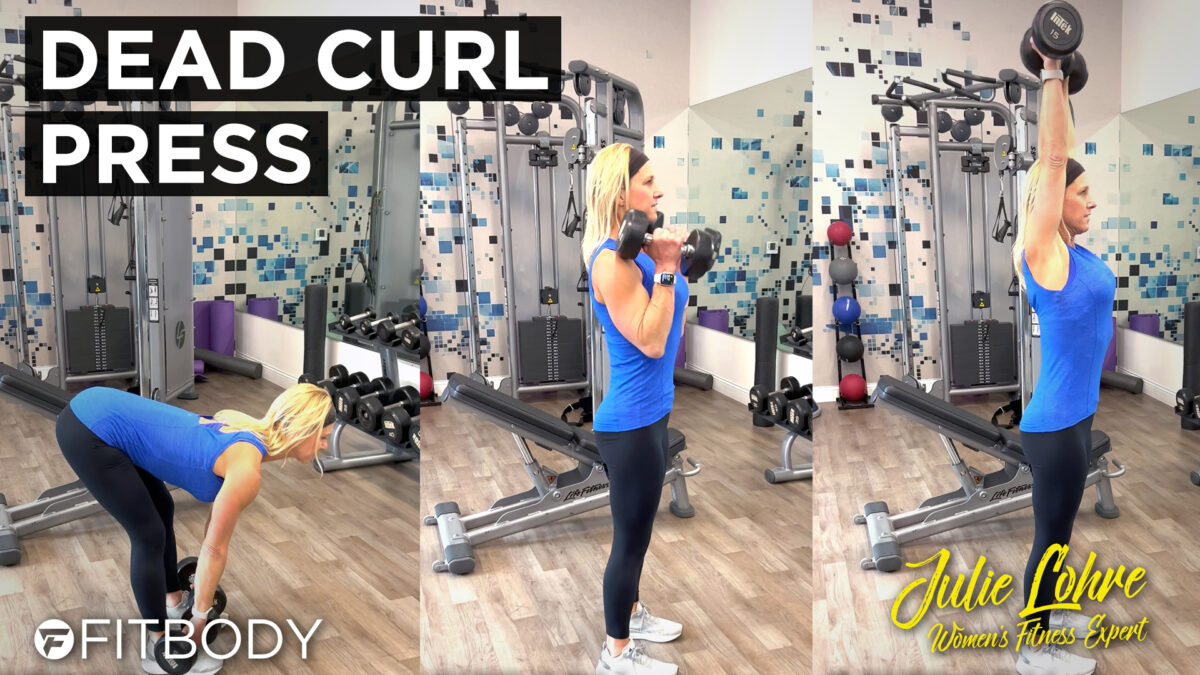
The dead curl press is a combination exercise that connects three familiar strength movements into a single repetition. You begin with a dumbbell deadlift, stand and perform a biceps curl, then finish with an overhead shoulder press.
Each phase has a different primary job. The deadlift portion trains the hip-hinge pattern and involves the glutes, hamstrings, quadriceps, and spinal erectors. The curl emphasizes the elbow flexors, particularly the biceps brachii. The press shifts the emphasis to the deltoids and triceps.
Combining the movements does not replace training each exercise separately, especially when your goal is to maximize strength in a specific lift. Instead, the dead curl press is a useful full-body option when you want several movement patterns in one exercise and can perform each part with consistent form.
How to Do the Dead Curl Press
Choose your dumbbells based on the weakest part of the sequence, which is often the curl or overhead press. If the weight is appropriate for your deadlift but forces you to swing through the curl or lean backward during the press, it is too heavy for the combination. Make each part look like a clean repetition of that exercise before moving to the next.


Why Combine a Deadlift, Curl, and Press?
The dead curl press lets you train several movement patterns without changing equipment. That can make it useful in a full-body dumbbell workout, circuit, or conditioning session where exercise transitions need to stay simple.
The three portions still have distinct muscular demands. A systematic review of deadlift research found substantial involvement from the erector spinae, quadriceps, gluteus maximus, and hamstrings, although activation varies with deadlift technique and variation. Research on dumbbell curls confirms substantial biceps brachii involvement during elbow flexion, while studies of overhead pressing show considerable deltoid and triceps activity.
There is not strong direct research on the complete dead curl press sequence itself. Evidence from the individual movements helps explain which muscles participate, but it does not establish that combining them produces greater fat loss or muscle growth than performing appropriately programmed exercises separately.
What Muscles Does the Dead Curl Press Work?
The dead curl press is a full-body combination exercise, so no single muscle is responsible for the entire repetition. The muscular emphasis changes as you move from the hip hinge to the curl and then to the overhead press.
The lower-body portion involves the glutes, hamstrings, quadriceps, and spinal erectors. The biceps and other elbow flexors become more prominent during the curl. The deltoids and triceps take on larger roles during the overhead press, while your trunk muscles help maintain position throughout the sequence.
See the full muscle breakdown
- Gluteus maximus: Contributes to hip extension as you rise from the deadlift portion and return to standing.
- Hamstrings: Assist hip extension and help control the hip hinge during the lowering and standing phases.
- Quadriceps: Contribute as the knees extend while you return to standing from the deadlift portion.
- Spinal erectors: Work to maintain and control trunk position during the loaded hip hinge.
- Biceps brachii and other elbow flexors: Bend the elbows to bring the dumbbells from your sides toward your shoulders.
- Deltoids: The anterior and middle portions contribute strongly as the dumbbells are pressed overhead.
- Triceps: Extend the elbows during the overhead press and help complete the pressing portion of the repetition.
- Trunk muscles: Help maintain torso position as the exercise moves from a hinge to standing and then overhead.
Sets and Reps
Because every repetition contains three different exercises, dead curl presses can become demanding quickly. Use a weight that allows clean technique during all three phases rather than selecting dumbbells based only on how much you can deadlift.
| Goal | Sets | Reps |
|---|---|---|
| Learning the sequence | 2 to 3 | 5 to 6 |
| Full-body strength accessory | 3 to 4 | 6 to 10 |
| Conditioning circuit | 2 to 4 | 8 to 12 |
Rest about 60 to 120 seconds between strength-focused sets, or program the exercise within a circuit when conditioning is the goal. One deadlift, one curl, and one overhead press equals 1 repetition. Add load only when all three portions remain controlled. See my guide to progressive overload for women for more ways to progress resistance training.
Dead Curl Press Variations and Modifications
Dumbbell Dead Curl Press
The version demonstrated here uses a dumbbell in each hand. Dumbbells allow each arm to move independently and make it easy to adjust the load in small increments.
Barbell Dead Curl Press
The same basic sequence can be performed with a barbell. The bar changes the grip and arm path, so practice the individual deadlift, curl, and press positions before combining them.
Deadlift to Curl Only
Leave out the overhead press and perform the deadlift followed by the curl. This shortens the sequence when overhead pressing is not part of your current program.
Curl to Press
Remove the deadlift and combine only the standing dumbbell curl with the overhead press. This reduces the lower-body component and lets you concentrate on the upper-body transition.
Dumbbell Thruster
For another full-body dumbbell combination, a thruster combines a squat with an overhead press. The lower-body movement and transition are different from the hip hinge and separate curl used in the dead curl press.
Common Dead Curl Press Mistakes to Avoid
- Choosing the weight from your deadlift strength. Your curl or overhead press will usually limit the load. Choose dumbbells you can control through the entire sequence.
- Squatting instead of hinging. Push your hips backward during the deadlift portion rather than dropping straight down as you would in a squat.
- Rounding during the deadlift. Keep the dumbbells close and use a range that allows you to maintain a controlled trunk position.
- Swinging through the curl. Finish standing before curling and keep your torso upright instead of using hip momentum to throw the weights toward your shoulders.
- Leaning backward during the press. Keep your ribs controlled as the dumbbells travel overhead rather than turning the finish into a large lower-back arch.
Dead Curl Press FAQs
What is a dead curl press?
A dead curl press is a combination exercise that connects a deadlift, biceps curl, and overhead press into one repetition. You hinge with the dumbbells, return to standing, curl them to your shoulders, and then press them overhead. This brings lower-body and upper-body movement patterns together without changing equipment. It can be used in full-body strength workouts or conditioning circuits.
What muscles does the dead curl press work?
The dead curl press works several major muscle groups because each phase has a different muscular emphasis. The deadlift portion involves the glutes, hamstrings, quadriceps, and spinal erectors. The curl emphasizes the biceps and other elbow flexors, while the overhead press uses the deltoids and triceps. Your trunk and upper-back muscles also contribute to maintaining position throughout the sequence.
Is the dead curl press good for weight loss?
Dead curl presses can be included in a training program designed to support fat loss, but the exercise itself does not guarantee weight loss or target body fat. It uses multiple muscle groups and can be programmed in a way that makes a workout physically demanding. Changes in body fat depend primarily on your overall energy balance, nutrition, activity, and training program over time. Use the dead curl press as a strength or conditioning exercise rather than treating it as a special fat-loss movement.
How heavy should I go on the dead curl press?
Choose a load based on the weakest part of the three-movement sequence rather than your strongest portion. For many people, the biceps curl or overhead press limits the appropriate dumbbell weight before the deadlift does. You should be able to complete every phase without swinging, rushing, or changing your body position to move the weights. Increase the load gradually once all three portions remain controlled throughout your target repetition range.
Is the dead curl press a strength or cardio exercise?
The dead curl press is a resistance exercise, but it can also increase the cardiovascular demand of a workout when performed for repeated repetitions or within a circuit. How it functions in your program depends on the load, repetition range, rest periods, and surrounding exercises. Heavier loads with more rest emphasize strength training, while lighter loads and shorter rest periods increase the conditioning demand. Technique should remain controlled regardless of how you program it.
Should beginners do the dead curl press?
Beginners can work toward the dead curl press, but it is usually easier to learn the deadlift, biceps curl, and overhead press separately first. Combining three movements adds coordination and makes it harder to correct one part while the sequence is moving. Practice each component until its basic technique feels consistent, then combine them using light dumbbells. There is no need to rush into the full combination if one portion still needs work.
Is the dead curl press safe or good for women over 40?
The dead curl press can be appropriate for women over 40 who can comfortably perform a hip hinge, biceps curl, and overhead press. Age alone does not determine whether the exercise is suitable. Start with manageable dumbbells and learn each component separately if needed before combining them. Persistent back, shoulder, elbow, or other joint pain during the movement should be assessed rather than trained through.
References
- Martín-Fuentes, Isabel, et al. “Electromyographic Activity in Deadlift Exercise and Its Variants. A Systematic Review.” PLOS ONE, vol. 15, no. 2, 2020, e0229507. doi.org/10.1371/journal.pone.0229507. The review included 19 studies examining muscle activation during deadlifts and deadlift variations. Results support involvement of the erector spinae, quadriceps, gluteus maximus, and hamstrings, but the review did not study the complete dead curl press.
- Marcolin, Giuseppe, et al. “Differences in Electromyographic Activity of Biceps Brachii and Brachioradialis While Performing Three Variants of Curl.” PeerJ, vol. 6, 2018, e5165. doi.org/10.7717/peerj.5165. The study examined biceps brachii and brachioradialis activity during dumbbell and barbell curl variations. It supports the elbow-flexor demands of the curl portion but did not test a combination exercise.
- Saeterbakken, Atle H., and Marius S. Fimland. “Effects of Body Position and Loading Modality on Muscle Activity and Strength in Shoulder Presses.” Journal of Strength and Conditioning Research, vol. 27, no. 7, 2013, pp. 1824-1831. doi.org/10.1519/JSC.0b013e318276b873. Fifteen healthy men performed seated and standing barbell and dumbbell shoulder presses. Standing dumbbell pressing produced high deltoid activity, but the study did not test the preceding deadlift or curl sequence.
Train With An Expert
Want a Plan Built Around You?
I’m Julie Lohre, an IFBB Fitness Pro and certified personal trainer and nutrition specialist. For more than 20 years I have helped women over 40 get stronger, leaner, and more confident through personalized online coaching built around their real lives.