
FITBODY Success Story · Getting Fit at 60
Getting Fit at 60: How Valerie Lost 20 Pounds After Menopause and Got Lean and Strong
Plenty of women are told that once they pass menopause, the body they want is gone for good. Valerie decided ahead of time that she would be fit at 60, and she proved that losing fat and building lean muscle is absolutely possible in your sixties. This is her story, and the real strategy behind it.


“I love being fit and how I look in my clothes. No more trying to disguise the fat areas. I was doing my Clean and Press movements in front of the mirror and I noticed the muscles on the underside of my upper arms and my shoulders. I don’t even recognize myself. I love it. Not big, huge muscles, but very lean and defined.”
Valerie Lewis, Kenai Peninsula, AlaskaValerie at a Glance
Is It Possible to Get Fit and Lose 20 Pounds After Menopause?
If you are approaching 60 and wondering whether you can still change your body, you are asking the right question, and the answer is one I get to prove again and again with the women I coach.
Yes. You can absolutely lose fat and build lean muscle at the same time, a process called body recomposition, and get genuinely fit at 60. A woman’s body responds differently in her fifties and sixties than it did in her twenties and thirties, but different does not mean impossible. With smart nutrition, consistent strength training, and daily movement, women get fit at 60 all the time. Valerie is a perfect example. She decided ahead of time that she would be fit at 60, then went and did it, dropping 21 pounds in seven months after menopause.
How the Female Body Changes at 60
As women move into their fifties and sixties, hormonal shifts, a quieter metabolism, and changes in muscle mass can make progress feel harder to come by. After menopause, estrogen declines, which nudges the body to store more fat around the middle and can make weight loss feel more stubborn. Muscle tissue also tends to fade with age when it is not actively maintained, which is exactly why strength training becomes so important for women over 60. A 2012 review in Climacteric describes how the menopause transition shifts both body weight and where fat is stored, the menopause belly so many women notice. If that midsection is your main frustration, my guide on what to eat to lose menopause belly fat goes deeper.
Bone density, joint comfort, and energy can shift too, and none of it has to hold you back. The female body at 60 still builds muscle, still responds to training, and still leans out when the plan is right. That is the whole point of Valerie’s story, and it reflects everything I teach about how to lose weight during menopause.
Valerie’s Fit at 60 Before and After
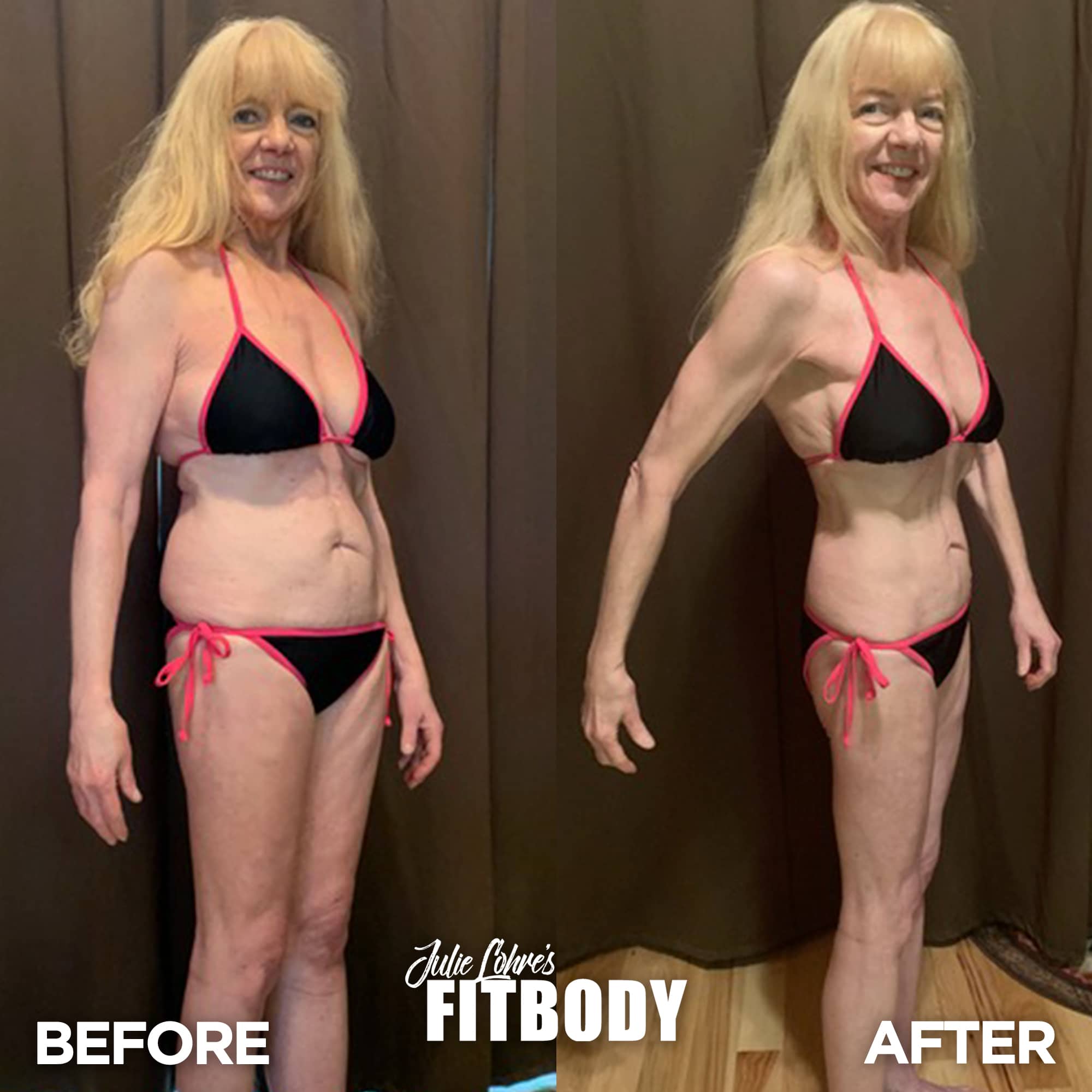
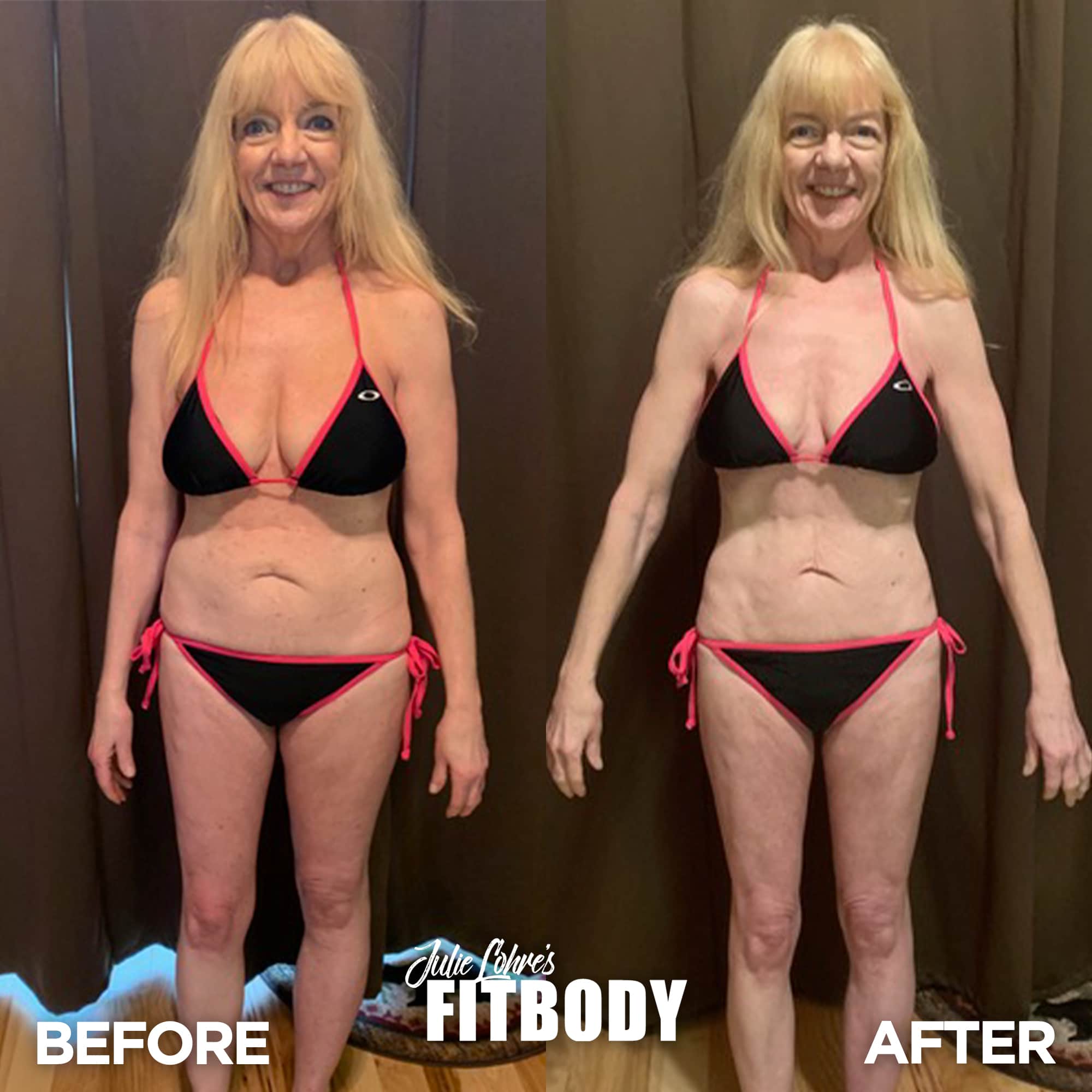
From Over 200 Pounds to Fit at 60: Valerie’s Story
Valerie was born and raised in Minneapolis and has spent the last 30 years in Alaska. She met her husband at 17, and they have been married more than 34 years. They have one grown daughter and a seven year old terrier mix named Wolfy. She earned an associate degree and has spent years in the admin field, packaging mortgage loans and doing credit counseling for the last decade.
“When I was 35-45, my life was extremely difficult and stressful and I took comfort in food and my weight got up to over 200 pounds. I had tried everything almost under the sun to lose weight.”
Valerie Lewis
Those years were brutal, between stressful work, raising a teenager, and caring for aging and ill parents. She also learned that her left leg was filled with blood clots, the result of a blood condition she was born with, which made exercise painful for a long stretch when her left leg measured three inches bigger than her right. Like many women, she found comfort in food, and her weight climbed past 200 pounds. She had been going to the gym her whole adult life, but she did not know how to train correctly.


Around 42, food allergies entered the picture. Once she figured out she was reacting to trans fats, hydrogenated oils, and dairy and cut them out, 50 pounds came off almost on its own. That early win lit a fire to train harder. Acupuncture helped calm her severe allergies, and over a couple of steady years she lost two inches off her left calf, stopped needing to carry an epi pen, and sailed through menopause with no hot flashes or night sweats.
Then at 50 she was diagnosed with osteoarthritis in both hands and had to change how she did things to protect her joints. Still, no matter what she tried, she could not shift the weight around her middle. She would build some nice definition in her arms and legs, then look down and see the same stubborn midsection staring back.
Getting Her Family Involved Was a Turning Point
One of the best things that happened was that Valerie’s husband started training too. He got serious about lifting and researching, and he became her built in support system. She began eating protein first thing in the morning and again within 20 minutes of her workouts. He also got her taking BCAAs to help her recover and keep soreness down.
That last detail matters more than most women realize. Supplements are an area women over 60 routinely overlook, and a couple of simple ones make a real difference. Two I find women in their sixties are almost never taking, and really should consider, are collagen peptides for skin, hair, and joint support, which becomes even more valuable as joints change and skin loses elasticity, and a quality protein powder that makes hitting a daily protein target realistic. You can find the ones I trust over on my supplement site, FITBODY.com.
Still, even with her husband in her corner, Valerie knew she needed expert direction. After years of going it alone and trying a couple of local trainers without the results she wanted, she was ready for a real plan.
“I kept thinking I will never get rid of this extra around my middle.”
Valerie Lewis
Her husband came across online fitness coach Julie Lohre in his research and encouraged her to reach out. She hesitated at first, unsure about coaching that happened entirely online, but she had already learned that local trainers were not getting her to the flat, strong midsection she wanted. So she reached out, hoping Julie could take her on.
Why Strength Training Is the Key for Women Over 60
The instinct after menopause is to do more cardio and eat less. It rarely works, because it strips away the very muscle that keeps your metabolism and your strength alive. The better path for women over 60 is to lift. Strength training for women rebuilds the lean muscle that age and years of dieting quietly take, and that muscle is what gives you shape, a faster metabolism, and the strength to stay independent for decades.
The research backs this up clearly. A position statement in the Journal of Strength and Conditioning Research lays out how resistance training improves strength, function, and body composition in older adults, and a 2023 analysis in Menopause found that resistance, aerobic, and combined exercise all meaningfully reduce fat mass and waist circumference in postmenopausal women. A 2023 controlled study in BMC Women’s Health went further, showing that postmenopausal women change their body composition in response to resistance training. Translation: your body is still listening.


The best exercises for women over 60 are the ones that build strength without punishing the joints. I lean on compound movements like squats, rows, and presses with dumbbells or machines, paired with low impact cardio like walking, cycling, or swimming. For Valerie, whose hands carry osteoarthritis, that meant training around her joints rather than through them, a simple adjustment that let her keep getting stronger without pain.
Nutrition for a 60 Year Old Woman to Lose Weight After Menopause
So what does the right kind of eating look like for a woman over 60 who wants to lose 20 pounds after menopause? For Valerie, it started with hydration and the surprising discovery that she got to eat more, not less.
“I find that I am eating quite a bit more food than I used to. I guess (before working with FITBODY & Julie Lohre) I was eating way too many carbs and calories with no nutrients. Now, I never feel stuffed or starving. I feel perfectly comfortable all the time now. I can picture myself eating like this the rest of my life.”
Valerie Lewis
This was never a diet. It was a way of eating built on real food, eaten every few hours, built around the right daily calories for a woman over 40, with enough protein to protect her muscle as she leaned out. She tracks her protein, carbs, fat, and calories with an app so she always knows what she is giving her body, and an occasional small treat does no harm when the foundation is solid. That is the difference between a plan you endure and one you can keep for life.
Sample Meal Plan for a 60 Year Old Woman to Lose Weight After Menopause
While I adjusted Valerie’s nutrition every two weeks based on her progress and feedback, here is a sample of the kind of wholesome, satisfying day that fueled her fit at 60 transformation. This is one example of what a woman could eat as she approaches 60 or works to get fit at 60.
Meal 1, Oats with Veggie Omelet (420 cal)
1/2 cup oats, 1 cup blueberries, 1 scoop Collagen Peptides, 1 TBSP chia seeds, 1 whole egg and 2 egg whites, with cherry tomatoes, mixed peppers, onion, and spinach on the side
Prep: Cook the oats and stir the collagen and chia in while warm, then top with blueberries. Whisk the egg and whites and cook into a soft omelet folded around the sauteed veggies. This meal anchors the morning with collagen and complete egg protein together, which supports the connective tissue and lean mass that decline fastest after menopause, while the chia and blueberries bring anti-inflammatory omega-3s and antioxidants that help muscles recover from training.
Meal 2, Creamy Peanut Butter Protein Smoothie (225 cal)
1 scoop UMP Protein Powder, 1 TBSP peanut butter, 1 cup almond milk
Prep: Blend the UMP, peanut butter, and almond milk with ice until smooth and creamy. UMP is high in leucine, the amino acid that triggers muscle protein synthesis, and older women need a strong leucine dose at each meal to overcome the age-related anabolic resistance that makes muscle harder to build through your 50s and 60s.
Meal 3, Cali Fish Tacos (345 cal)
5 oz mahi mahi, 3 corn tortillas, 1/4 cup avocado, 2 TBSP salsa, 1 tsp olive oil, with asparagus on the side
Prep: Season the mahi with cumin, chili powder, and a little turmeric, then pan sear in the olive oil and flake into warmed corn tortillas with avocado and salsa. Lean white fish delivers high-quality protein with very little saturated fat, and pairing it with avocado’s monounsaturated fat and the fiber from corn tortillas supports the hormone and heart health that become priorities as estrogen drops.
Meal 4, Hearty and Healthy Chicken and Sweet Potatoes (630 cal)
6 oz chicken breast, 6 oz sweet potato with 1 TBSP butter and 0.5 oz walnuts on top, 1/2 TBSP olive oil, 3 oz baby carrots
Prep: Season the chicken with turmeric and black pepper and grill or pan sear in the olive oil, roast the sweet potato and top it with butter and chopped walnuts, and roast the carrots alongside. This is the biggest protein and carbohydrate meal of the day, ideal for the evening when it refuels glycogen and supplies the steady amino acids muscles use overnight to rebuild, while the walnuts add omega-3s and the sweet potato delivers the potassium and beta-carotene that support recovery and bone health.
Valerie’s 7 Month Progress
| February | September | 7 Month Change | |
|---|---|---|---|
| Weight | 135 | 113.8 | down 21.2 lbs on the scale |
| BMI | 21.5 | 19.7 | down 1.8 |
| Body Fat % | 28.1 | 20.6 | down 7.5 |
| Visceral Fat % | 5.0 | 4.0 | down 1.0 |
In just over seven months, Valerie showed that you can lose 20 pounds after menopause in a safe, healthy, natural way, without ever feeling deprived.
How Her Body Changed Working With Online Fitness Coach Julie Lohre
Valerie now weighs between 113 and 115 pounds, the same weight she was when she first met her husband. Her BMI is finally under 20, she beat her goal to lose 20 pounds after menopause, and she lost the love handles that had frustrated her for years. There is a little loose skin, but her tummy is flatter than it has been in a long time, with no more menopause belly. She knows she still has muscle to build, and she is on an upward path she plans to stay on. She is, in her words, addicted to the gym, and she rounds out her training with walking her dog, yoga at home, and cross country skiing through the Alaska winters.

“I don’t even recognize myself. I love it. Not big, huge muscles, but very lean and defined.”
Valerie Lewis


Fit, Strong, and Looking Like a Fitness Model at 60
Somewhere along the way, Valerie’s goal shifted from simply losing weight to wanting to look the part of a bikini fitness model, lean and defined enough that she could step on a fit model stage if she ever chose to, without any need to actually compete. That is the fit model look without competing, and it is exactly what so many women over 40 and over 60 are really after. She had an aunt who wore a bikini at 74, and that image stuck with her as proof of what was possible.
She also carries a line from an old aerobics instructor that still makes her smile.
“You grew it, you lift it.”
Valerie’s favorite reminder
What It Is Like Working With Online Fitness Coach Julie Lohre
In Valerie’s words, the exercises keep changing, so she never walks into the gym wondering what to do. She is no longer repeating the same routine month after month, and when she meets a movement she does not know, she pulls it up in my online exercise database. Questions get answered promptly, encouragement is constant, and she loves reading the articles in FITBODY Magazine along with the inspirational emails. She describes having a great team in her corner, her husband and her coach both.
Knowing what works and executing it week after week, while real life happens, are two very different things. That gap is exactly what coaching closes. Here is how I build a fit at 60 transformation for a woman over 60.
- It starts with your real data. Every client begins with detailed intake, photos, and a live phone consultation, so the plan is built around your body, your history, your injuries, and your schedule, not a template.
- Calories are placed to fuel results, not to starve. Very low calorie plans are never the strategy, because protecting your metabolism is the whole point. Like Valerie, most women are surprised to find they get to eat more.
- Strength leads, in focused four week blocks. Three to five sessions a week, built to progress and then change completely, so your body keeps adapting instead of stalling, and always working around your joints rather than through them.
- Progress is read the right way. Photos come first, with measurements, the scale, strength, and how you feel filling in the picture. The scale alone is never the verdict.
- The plan evolves on a schedule. Nutrition is reviewed every two weeks and training every four, with small, intentional adjustments based on real trends, never a reaction to one off day.
- You work directly with me. The same coach, every check in and every question, answered by me personally.
“I can picture myself eating like this the rest of my life.”
Valerie Lewis, Fit at 60, Kenai Peninsula, AlaskaCommon Questions About Getting Fit and Losing Weight After 60
Is it possible to get in shape at 60?
Yes, getting in shape at 60 is absolutely possible, and I see women do it every year. Your body still builds muscle, loses fat, and gains energy in your sixties when training and nutrition are done right. The real difference at 60 is not that your body stopped responding, it is that the old approach of eating less and doing more cardio quietly works against you. With consistent strength training, enough protein, and daily movement, a woman over 60 can reshape her body in a matter of months. Valerie did exactly that at 60, losing 21 pounds in seven months and finally seeing lean, defined muscle for the first time.
Is it harder to lose weight after 60, or is my metabolism broken?
Your metabolism is almost certainly not broken. A large 2021 study in Science that measured energy use in more than 6,400 people found that metabolism, adjusted for body composition, stays remarkably steady from age 20 to 60 and only begins a slow decline after that. What actually makes weight loss feel harder after 60 is the gradual loss of muscle and the drop in daily movement that build up over the years, often sped along by repeated dieting. Both of those are fixable. When you rebuild muscle with strength training and move more through the day, your body responds, which is exactly what happened for Valerie.
How do you lose weight after menopause?
You lose weight after menopause by protecting and rebuilding muscle while eating enough to fuel it, not by slashing calories. As estrogen falls, fat storage shifts toward the belly, a change documented in a 2012 review in Climacteric, so the strategy has to change too. Strength training three to four times a week, a protein forward way of eating, and consistent daily movement work together, and a 2023 analysis in Menopause found that resistance, aerobic, and combined exercise all reduce fat mass and waist size in postmenopausal women. The women I coach are almost always surprised that they lose weight while eating more food than before, not less. Valerie lost 20 pounds after menopause this way and never felt deprived.
How many calories should a 60 year old woman eat to lose weight?
Most women over 60 lose weight on somewhere between 1,500 and 1,800 calories a day, but the right number depends on your size, activity, and dieting history rather than a generic chart. The most common mistake I see is starting too low, which costs you muscle and stalls progress within a few weeks. I calculate each woman’s intake from her resting metabolic rate and her real daily activity, then adjust it every two weeks based on how her body actually responds. Valerie started around 1,600 calories and ate more food than she had on the crash diets that never worked. You can see how I run the numbers in my guide on the right daily calories for a woman over 40.
How much protein does a woman over 60 need?
A good target is roughly 1.6 grams of protein per kilogram of body weight per day, the amount a 2018 review in the British Journal of Sports Medicine found maximizes muscle and strength when paired with resistance training. For many women over 60 that lands around 90 to 120 grams a day, far more than most are eating. Protein matters even more after menopause because it protects the muscle you are working to keep, and it keeps you full, which makes a calorie deficit feel manageable instead of miserable. I have most women anchor every meal around a protein source and start the day with protein, exactly as Valerie learned to do.
What should a 60 year old woman eat to lose weight?
A 60 year old woman losing weight should build each meal around protein, fill in with whole food carbs and healthy fats, and eat every few hours so she is never starving. That usually means more real food and better food, not a tiny restrictive diet. A simple day might look like the sample on this page: oats with a veggie omelet, a peanut butter protein smoothie, fish tacos, and chicken with sweet potato. The aim is a way of eating you could keep for life, which is why Valerie says she can picture eating like this forever.
Can a 60 year old woman still build muscle?
Yes, a 60 year old woman can absolutely build muscle, and it is one of the most protective things she can do for her health. A 2023 controlled study in BMC Women’s Health showed that postmenopausal women change their body composition in response to resistance training. Building muscle does far more than reshape your body, it raises your metabolism and improves balance and posture, and a 2025 meta-analysis in the Journal of Orthopaedic Surgery and Research found resistance training meaningfully improves bone density at the spine and hip, directly countering the bone loss that speeds up after menopause. Valerie built lean, defined muscle at 60, in her words muscle she did not even recognize on herself.
What is the best exercise for women over 60?
The best exercise for women over 60 is strength training, supported by daily walking and a little low impact cardio. A position statement in the Journal of Strength and Conditioning Research details how resistance training improves strength, function, and body composition in older adults, which is why it anchors every plan I write. I favor compound movements like squats, rows, and presses with dumbbells or machines, because they build the most muscle for your time and can be adjusted around any joint that needs care. Cardio and steps support the work, but lifting is what actually changes the shape of your body at 60.
Do you need cardio to lose weight after menopause, or is strength training enough?
You do not need hours of cardio to lose weight after menopause, and leaning on it alone usually backfires. Cardio burns calories while you do it, but strength training changes your body’s engine by rebuilding the muscle that keeps your metabolism active around the clock. The approach that works is strength training as the foundation, a daily step target around 10,000, and just enough cardio to support recovery and heart health. After years of endless cardio, that shift is what finally worked for Valerie, and it is the change I make with most women over 60.
How can women over 60 lose belly fat after menopause?
Losing belly fat after menopause comes down to building muscle, eating enough protein, managing stress and sleep, and staying active, not endless crunches. As estrogen falls, the body stores more fat around the middle, a shift described in a 2012 review in Climacteric, so the menopause belly is hormonal, not a personal failing. Strength training three to four times a week plus a protein forward diet does the heavy lifting, while better sleep and lower stress calm the cortisol that drives belly fat storage. For the food side specifically, my guide on what to eat to lose menopause belly fat goes deeper. Valerie lost her menopause belly and her love handles with this exact approach.
Is strength training safe for women over 60 with arthritis?
For most women, strength training is safe with arthritis and is widely recommended as part of managing it, because stronger muscles support and protect the joints. The evidence is strongest for knee and hip osteoarthritis, where strengthening is a core part of standard care. For hand osteoarthritis like Valerie’s, the research is more limited, and a 2017 review in Arthritis Research and Therapy found the training programs studied did not significantly improve grip strength, with the authors noting those programs were often too gentle to drive change. The practical answer, and what I do with clients, is to train around the affected joints rather than through them, using straps, machines, and grip adjustments so the working muscles still get a real stimulus without aggravating the hands. Valerie has osteoarthritis in both hands and still built lean, defined muscle by adjusting how she trained, never by forcing through pain.
How long does it take to get in shape at 60?
Most women start feeling more energy and strength within four to six weeks of consistent training, with visible fat loss and muscle tone following over the next three to six months. A realistic, healthy pace is losing roughly half a pound to one percent of your body weight per week, which protects the muscle you are building. That steady rate is exactly what makes the results last instead of bouncing back. Valerie lost just over 21 pounds in seven months, right in that sustainable range, and she has stayed on that upward path since.
Research Supporting Fitness and Weight Loss After Menopause
- Davis, S. R., et al. “Understanding Weight Gain at Menopause.” Climacteric, vol. 15, no. 5, 2012, pp. 419–429. Taylor and Francis Online.
- Fragala, Matthew S., et al. “Resistance Training for Older Adults: A Position Statement From the National Strength and Conditioning Association.” Journal of Strength and Conditioning Research, vol. 33, no. 8, 2019, pp. 2019–2052. Lippincott Journals.
- Isenmann, E., et al. “Resistance Training Alters Body Composition in Middle-Aged Women According to Menopause Status: A Controlled Study.” BMC Women’s Health, vol. 23, 2023, article 284. BMC Women’s Health.
- Khalafi, M., et al. “The Effects of Exercise Training on Body Composition in Postmenopausal Women: A Systematic Review and Meta-Analysis.” Menopause, vol. 30, no. 8, 2023, pp. 1000–1012. PMC.
- Magni, N. E., et al. “The Effects of Resistance Training on Muscle Strength, Joint Pain, and Hand Function in Individuals with Hand Osteoarthritis: A Systematic Review and Meta-Analysis.” Arthritis Research and Therapy, vol. 19, 2017, article 131. Arthritis Research and Therapy.
- Morton, Robert W., et al. “A Systematic Review, Meta-Analysis and Meta-Regression of the Effect of Protein Supplementation on Resistance Training-Induced Gains in Muscle Mass and Strength in Healthy Adults.” British Journal of Sports Medicine, vol. 52, no. 6, 2018, pp. 376–384. PMC.
- Pontzer, Herman, et al. “Daily Energy Expenditure through the Human Life Course.” Science, vol. 373, no. 6556, 2021, pp. 808–812. Science.
- Yun, Hezhang, et al. “Optimal Resistance Training Parameters for Improving Bone Mineral Density in Postmenopausal Women: A Systematic Review and Meta-Analysis.” Journal of Orthopaedic Surgery and Research, vol. 20, no. 1, 2025, article 523. Journal of Orthopaedic Surgery and Research.
Your Story Could Be Next
Ready to Get Fit at 60?
Julie Lohre is an IFBB Fitness Pro, Certified Personal Trainer, and Certified Nutrition Specialist with 20+ years of experience coaching women over 40 to lose fat, build lean muscle, and get genuinely fit through my FITBODY Recomposition System™. If you are a woman in your fifties or sixties who is tired of guessing what works, I would love to help you do what Valerie did, build strength, lose weight after menopause, and feel incredible again.