FITBODY Exercise Library · Arms & Biceps
Hammer Curls
Hammer curls are a classic dumbbell exercise that build stronger, more sculpted arms by hitting the brachialis, biceps brachii, and brachioradialis in one clean neutral-grip movement. A must-have for women who want defined arms and better grip strength.
What Are Hammer Curls?
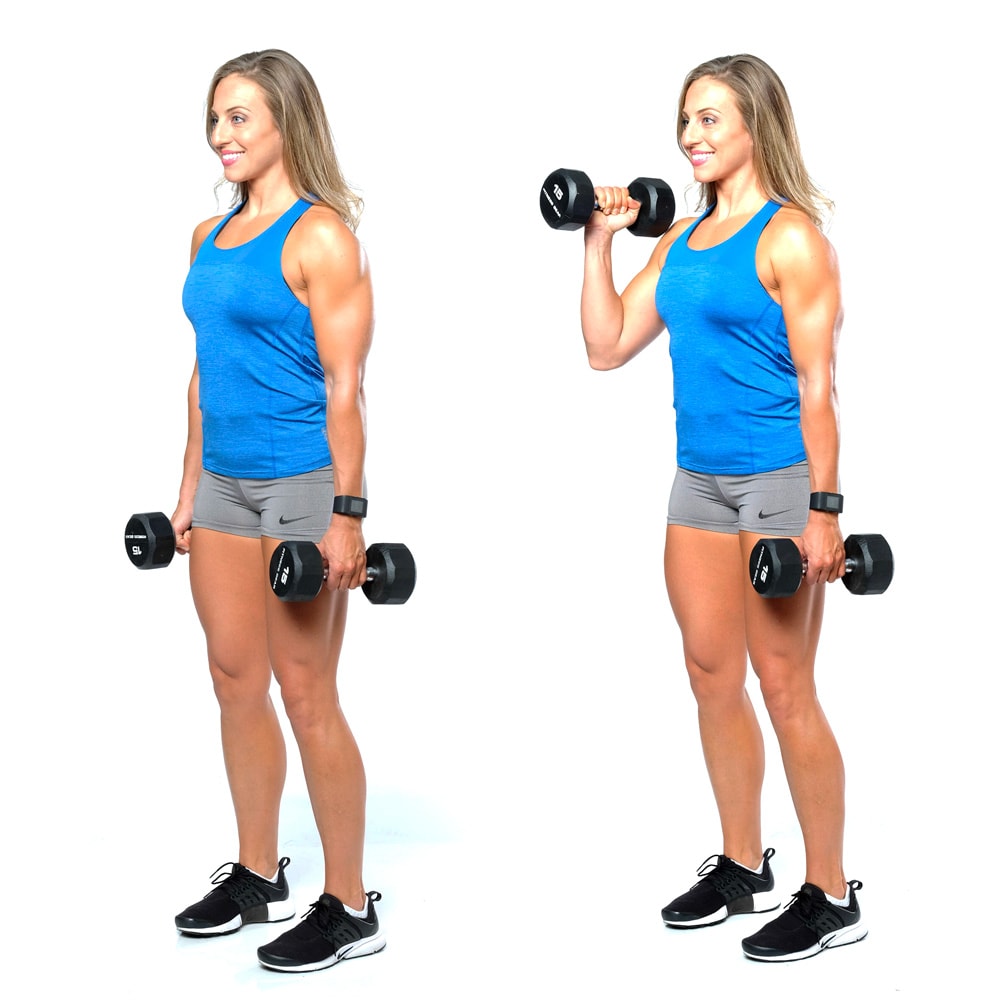
Hammer curls, also known as dumbbell hammer curls or DB hammer curls, are a bicep exercise performed with a neutral grip, with palms facing each other. Instead of curling with your palms rotated up like a standard bicep curl, you hold the dumbbells vertically like a hammer and curl them straight up. This small grip change makes a big difference. It places unique emphasis on the brachialis, a key muscle sitting underneath the biceps, while still training the biceps themselves. The result is arms that look thicker, feel stronger, and grip better, and it is a movement I lean on inside the arm training I build for my FITBODY Recomposition System.

What Muscles Do Hammer Curls Work?
Hammer curls primarily target the brachialis and the biceps brachii, with strong secondary involvement from the brachioradialis of the forearm and the forearm flexors. Because the neutral grip removes the wrist supination of a standard curl, the load shifts more directly onto the brachialis and brachioradialis. That is where a lot of overall arm thickness comes from and why hammer curls are one of the best exercises for building the brachioradialis. Research on curl variations and grip position confirms the neutral hammer grip changes activation patterns compared with a standard supinated curl.
See the full muscle breakdown
- Brachialis: the primary mover in the neutral grip position, sits underneath the biceps and adds significantly to overall arm thickness.
- Biceps brachii: flexes the elbow through the movement and contributes to total pulling strength.
- Brachioradialis: a strong forearm muscle that fires hard during neutral grip curls, contributing to grip strength and arm stability.
- Forearm flexors: support the neutral grip and stabilize the wrist through every rep.
- Core and obliques: brace the trunk and prevent swaying or arching under the load.
Benefits of Hammer Curls
Hammer curls earn their spot in almost every well-built arm workout for good reason. Here is what makes them worth doing consistently.
- They target more than just the biceps. Hammer curls emphasize the brachialis and forearms, contributing to overall arm thickness and total pulling strength in a way that standard curls do not.
- They improve grip strength. The neutral grip requires active forearm engagement, which improves grip strength, a critical factor for many exercises and daily activities.
- They support functional strength. The neutral grip mimics real-life lifting motions, like carrying grocery bags or luggage, making hammer curls a functional exercise for everyday strength.
- They are joint-friendly. The neutral grip reduces strain on the wrists and elbows, making hammer curls a great choice if you feel discomfort with traditional palms-up curls.
- They build brachioradialis strength. One of the few curl variations that directly trains the brachioradialis, a forearm muscle that most other bicep exercises barely touch.
How to Do a Hammer Curl
Keep your core tight to prevent swaying or arching your back, move slowly to maximize muscle activation and minimize momentum, and complete each curl through a full range of motion. Ten clean, controlled reps will build stronger arms than fifteen sloppy ones.

Hammer Curl Hand Position
The hand position is what makes a hammer curl a hammer curl. Instead of the palms-up (supinated) grip of a standard bicep curl, hammer curls use a neutral grip, meaning palms face each other throughout the entire movement. Think of holding the dumbbells vertically, like you are gripping a pair of hammers.
This grip position shifts the load away from the biceps brachii alone and onto the brachialis and brachioradialis, which is what gives hammer curls their unique benefits. It also feels friendlier on the wrists and elbows than palms-up curls, especially if you have any joint sensitivity.

Sets and Reps
Program hammer curls one to two times per week as part of an arm-focused day, an upper body day, or a full body session. Progress gradually with reps or load.
| Goal | Sets | Reps |
|---|---|---|
| Strength and arm thickness | 3 to 4 | 8 to 10 |
| Hypertrophy and definition | 3 | 10 to 12 |
| Endurance and grip | 2 to 3 | 12 to 15 |
Rest 60 to 90 seconds between sets. If you have any active elbow pain, tendinopathy, or wrist injury, clear this and any curling work with your physical therapist or physician before adding it in.
Hammer Curl Variations
Alternating Hammer Curls
The most common version. Curl one arm at a time, alternating sides. The offset load lets your trunk stabilize one arm at a time and helps you focus on clean, controlled reps. A great starting point for beginners.
Simultaneous Hammer Curls
Curl both arms at the same time instead of alternating. Adds a stability challenge and lets you focus on total arm activation on every rep. A great progression once your alternating form feels clean and controlled.

Seated Hammer Curls
Perform the exercise seated on a bench with a straight back and braced abs. Eliminates any lower body momentum and isolates the arms even more. Smart option when you want to force the biceps and brachialis to do all the work.
Cable Rope Hammer Curls
Use a rope attachment on a cable machine to add consistent tension throughout the movement. The cable maintains resistance where dumbbells lose it at the top of the curl, which extends time under tension for the biceps and brachialis.
Cross-Body Hammer Curls
Instead of curling straight up, curl the dumbbell across your body toward the opposite shoulder. Shifts the load slightly and adds a strong contraction on the brachialis. Alternate sides on every rep.
Related arm and upper body movements can be found in the FITBODY Exercise Library.
Common Mistakes to Avoid
- Using momentum. Swinging the dumbbells reduces the effectiveness of the exercise and raises the risk of injury. Slow, controlled movements are the goal.
- Letting the elbows drift. Your elbows should stay close to your torso the entire set. If they flare out or drift forward, the focus shifts away from the biceps and brachialis.
- Lifting too heavy. A weight that is too heavy compromises form and reduces the benefit. Start light, build clean reps, and add weight only when the form is solid.
- Dropping the weights on the way down. The lowering phase builds a huge amount of strength. Control the descent as much as you control the lift.
- Rotating the wrist mid-rep. The palms stay facing each other through the entire movement. The moment your wrist rotates up, you have turned this into a standard curl instead of a hammer curl.

How to Add Hammer Curls to Your Arm Workout
Hammer curls fit beautifully into arm-focused workouts or full-body routines. Here is a sample sequence you can use as a starting point on an arm day.
- Barbell Curl — 3 sets of 8 to 10 reps
- Hammer Curl — 3 sets of 10 to 12 reps
- 45 Degree Bicep Curl — 3 sets of 12 to 15 reps
- Reverse Curl — 3 sets of 10 to 12 reps
Rest 60 to 90 seconds between sets to maintain intensity throughout the workout.
Hammer Curl FAQs
What muscles do hammer curls target?
Hammer curls primarily target the brachialis and biceps brachii, with strong secondary involvement from the brachioradialis of the forearm and the forearm flexors. Because the neutral grip removes the wrist supination of a standard curl, the load shifts more directly onto the brachialis, the muscle underneath the biceps, and the brachioradialis of the forearm. That is where a lot of overall arm thickness comes from, which is why hammer curls are a smart addition for anyone chasing more sculpted, functional arms.
What are hammer curls good for?
Hammer curls are good for building overall arm thickness, improving grip strength, and developing the brachialis and brachioradialis, two muscles that standard bicep curls do not train as directly. They also mimic real-life lifting patterns like carrying groceries or luggage, so they carry over well to everyday activities. And because the neutral grip is joint-friendly, they are a smart choice for anyone with wrist or elbow sensitivity who cannot tolerate a full palms-up curl.
Are hammer curls a good exercise?
Yes, hammer curls are one of the best arm exercises you can do. They train the brachialis, biceps brachii, brachioradialis, and forearm flexors all in one clean movement, which makes them highly efficient. They also feel friendlier on the wrists and elbows than palms-up curls, making them a smart choice for women over 40 or anyone with joint sensitivity. In a well-built arm program, hammer curls belong alongside standard curls for balanced arm development.
Are dumbbell hammer curls effective for women?
Yes, dumbbell hammer curls are highly effective for women looking to build stronger, more defined arms. They target the brachialis and brachioradialis directly, which are the muscles that add real arm thickness and shape, and they build grip strength that carries into every other upper body exercise. Inside my FITBODY Lifestyle Coaching program, hammer curls are one of the go-to arm exercises because they deliver strong results with low joint stress.
What is the difference between a hammer curl and a bicep curl?
The difference is the grip. A standard bicep curl uses a supinated grip, with palms facing up, and emphasizes the biceps brachii most directly. A hammer curl uses a neutral grip, with palms facing each other, and shifts more of the load onto the brachialis and brachioradialis. Both are excellent arm exercises, and a well-rounded program typically includes both to hit the entire elbow flexor group.
How much weight should I use for hammer curls?
Start light and build. Most women land in the 8 to 15 pound dumbbell range for hammer curls, depending on training experience. The load only needs to be heavy enough to create real tension on the biceps and brachialis through 10 to 12 clean reps. If you find yourself swinging the weights, letting your elbows drift, or arching your back to complete the rep, drop the weight and reset. Clean reps at a lighter load build significantly more arm strength than sloppy reps at a heavier load.
How often should I do hammer curls?
One to two times per week is a strong dose for most women. Hammer curls fit inside an arm-focused day, an upper body day, or a full body session. Because they are an isolation movement for a small muscle group, more frequent work rarely produces additional benefit and often just leaves the elbows cranky. Rotate hammer curls with standard curls, 45 degree curls, and reverse curls for balanced arm development.
References
- Marcolin, Giuseppe, et al. “Differences in Electromyographic Activity of Biceps Brachii and Brachioradialis While Performing Three Variants of Curl.” PeerJ, vol. 6, 2018, article e5165, https://doi.org/10.7717/peerj.5165.

Train With An Expert
Want a Plan Built Around You?
I’m Julie Lohre, an IFBB Fitness Pro and certified personal trainer and nutrition specialist. For more than 20 years I have helped women over 40 get stronger, leaner, and more confident through personalized online coaching built around their real lives.