

FITBODY Online Personal Training for Women Over 40
How to Keep Weight Off After 40: Lose 20+ Pounds With Body Recomposition and Keep It
If you have more than 20 pounds to lose, you need a way to lose it that you can also keep. Here is how body recomposition works in your 40s and 50s, and what years of keeping it look like for real women.
 By Julie LohreIFBB Fitness Pro, Certified Personal Trainer, and Certified Nutrition Specialist with more than 20 years of experience coaching women over 40

“I do not want you to lose weight in an extreme way and then gain it back when we are done. I want you to reshape your body and build the habits that keep you there for life.”
Julie Lohre
In this article
- The short answer: results that last come from muscle, habits and direction
- Why do most women gain the weight back?
- What actually changes in your body in your 40s and 50s?
- What does lasting change look like? Meet Kelly
- Why was Renee gaining weight while running 600 miles a year?
- Which other women kept their results?
- How do I coach for results that last?
- Frequently asked questions
The short answer: results that last come from muscle, habits and direction
I do not want you to lose weight in an extreme way and then gain it back when we are done. If you have more than 20 pounds to lose, this is especially for you. My approach is body recomposition, delivered through my FITBODY Recomposition System™: lose fat while building and keeping muscle, reshape and define your body, and develop the habits that keep you there for life. After 40 that matters more than the number on the scale, because the real risk is not only gaining weight, it is losing muscle while you do it.
That is the difference between a diet and a lifestyle you keep. It is also why my coaching has no long term commitments: you start with an initial eight week block and can stop after it, because the goal is a body and a set of habits that belong to you.
Why do most women gain the weight back?
Most women gain it back because the way they lost it could not be kept up, and because crash dieting costs muscle. In a study of 14 contestants from The Biggest Loser (Fothergill et al., Obesity, 2016), the contestants lost an average of 58.3 kg during the competition and their resting metabolic rate dropped by 610 calories a day. Six years later they had regained an average of 41 kg of the weight they lost. That was an extreme television competition, and I would never coach it, but it shows what happens when a body is pushed hard and the approach cannot be sustained.
The pattern is not only about extremes. Many women I work with come to me after years of going from one diet to another. Shannon, 49, said it plainly:
“I always went from one diet to another with no lasting results. Now, I’m healthier, and in the best shape of my life… at 49!”
Shannon McLaughlin, 49
Read her full story: Shannon McLaughlin, 49, lost 20 pounds and is in the best shape of her life.
What actually changes in your body in your 40s and 50s?
Your body composition changes more than your metabolism. A 2021 study in Science (Pontzer et al.) found that calorie burn, adjusted for body size, stays stable from about age 20 into the 50s. In the SWAN study (Greendale et al., JCI Insight, 2019), the rate of fat gain doubled at the start of the menopause transition while lean mass declined.
Muscle is part of the story. According to UCLA Health, women lose about 3 to 8 percent of muscle mass per decade between 30 and 50, and 5 to 10 percent per decade beyond 50. Because muscle is metabolically active tissue, protecting it protects the calories you burn at rest. That is why I focus on keeping and building muscle, not on cutting calories as low as possible.
What does lasting change look like? Meet Kelly
Kelly has trained with me for more than two years. She started at 176 pounds with a 45 inch waist. She is now 30 pounds lighter, her waist is 14 inches smaller, and she has kept it that way through regular life. She can do more than 50 full push-ups, up from 11 on her knees, and she runs a mile in around 9:20, down from a 13:53 run/walk.
Kelly kept training because she values the accountability, direction and support. She did not want to think about plans. She wanted an expert to develop them and guide her.
“I truly thought I was in my final form before I started with Julie. But I was wrong. I look better now than I did when I was 30, and I feel better too.”
Kelly Smith, Austin, Texas

Read her full story: Kelly Smith’s 2 year body transformation.
Why was Renee gaining weight while running 600 miles a year?
Renee Cipriani, 53, of Sayler Park, Ohio, was already more active than most women her age. In one year she logged 615 miles running, 321 walking and 94 cycling, plus a half marathon, several 5Ks and a 15K, and she gained 20 pounds. The missing piece was not more cardio. It was a nutrition structure for her body and strength training alongside her running.
In 8 months working with me she lost 40 pounds and 7 inches off her waist, dropped 4 pants sizes, and did it while working full time as a paralegal, teaching part time and helping care for her 90 year old father. The part that matters for this guide is what it became: not a program she finished, but part of her everyday life.
- Timeframe: 8 months
- Weight: 40 pounds lost, with 25 of those pounds in her first 16 weeks
- Waist: down 7 inches, and 4 pants sizes
- Mile: 3 minutes 14 seconds faster after just 8 weeks
- 5K: a personal best of 30:57, 11th out of 74 women in her age group

“Through working with Julie, I learned how to eat to fuel and support my body, not just eat or count calories, and I am losing fat, gaining lean muscle, getting stronger and feeling great about the changes I am making.”
Renee Cipriani, 53
“Fitness is a solid part of my everyday life. I look forward to my weight lifting, stretching or cardio and get irritated if anything threatens to interfere with it.”
Renee Cipriani, 53
Read her full story: Renee Cipriani’s 40 pound weight loss before and after.
Which other women kept their results?
Kelly is not the only woman who built results that last. These are four more FITBODY clients, each in her own words.
Valerie Lewis: three years of training, and she kept her results
Valerie started at 60 and went from 135 to 113.8 pounds in seven months, with body fat down from 28.1% to 20.6%. She went on to train with me for three years and kept her results.
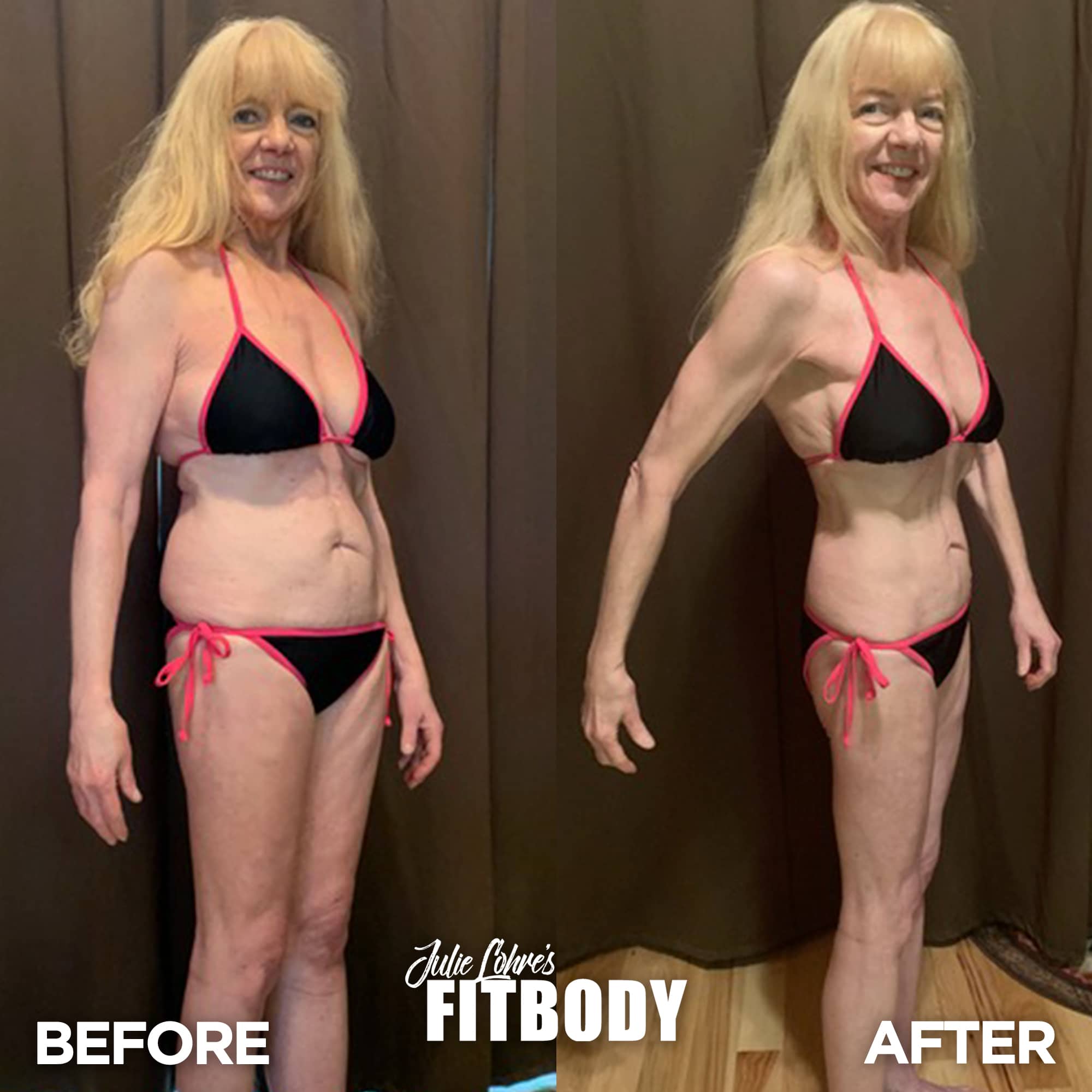
“I can picture myself eating like this the rest of my life.”
Valerie Lewis, 60, Kenai Peninsula, Alaska
Read her full story: Valerie’s fit at 60 transformation.
Michelle Moneck: a 2 year transformation she turned into a lifestyle
Michelle lost over 40 pounds, took 7 inches off her waist and cut her mile from 11:58 to 7:49 over two years. She had tried online training once before and was not ready. She came back, and she did not miss a check-in or workout.

“Fitness is now my lifestyle. I make it work whether I am at home, traveling, or on vacation.”
Michelle Moneck, Pittsburgh, Pennsylvania
Read her full story: Michelle Moneck’s 2 year weight loss transformation.
Chris Reeb: no extreme calorie deprivation
Chris lost about 40 pounds and cut her body fat in half in six months at 46. She had been through calorie deprivation before, and wanted a lifestyle she could maintain for the long run.
“I never went a day hangry, which was a total relief coming off calorie deprivation from the past.”
Chris Reeb, 46, Orchard Park, New York
Read her full story: Chris Reeb’s 6 month body transformation.
Michele Clancy: a way of life she never thought possible
At 52, after treatment for breast cancer and while taking tamoxifen, Michele lost 44 pounds on the scale in about a year. She gained about 5 pounds of muscle, took 11.5 inches off her waist and 14 off her hips, and went from 5 pushups to 44.

“Julie has given me back my health and a way of life I never thought possible.”
Michele Clancy, 52, Lynn Haven, Florida
Read her full story: Michele Clancy’s story of losing weight while on tamoxifen.
How do I coach for results that last?
My FITBODY Recomposition System™ combines progressive strength training in structured four week blocks, macro based nutrition calibrated to your body, a check-in and adjustment every two weeks, and progress tracking with photos, measurements and strength performance, not the scale alone. Every client works directly with me, not an app or an assistant. It is all meant to be something you can live with:
- No extreme dieting: I do not use fad diets or very low calorie diets. Your starting point is based on your full picture, and I revise your macros every two weeks with a new sample meal plan and permission to swap foods
- Muscle first: progressive strength training in four week blocks, with cardio in a supporting role
- Real life built in: travel and eating out are part of a macro based plan, and you do not need a gym
- Bone density and longevity: built into every client’s plan, especially for women in their 50s and 60s
- Accountability: photos and feedback first, then measurements and the FITBODY Fit Test every four weeks, all in writing and read by me
- No long term commitments: an initial eight week block, and you can stop after it
See how it works on my page for FITBODY Online Personal Training for Women Over 40.
FITBODY Online Personal Training for Women Over 40
Ready for Results That Last?
Fill out a short form and I’ll email you back quickly. Then we talk by phone. Nothing is paid before we talk.
Frequently Asked Questions
Why do I keep gaining weight back after I lose it?
Short answer: because the approach that took the weight off could not be kept up, and because it usually cost muscle along the way. In a study of 14 contestants from The Biggest Loser (Fothergill et al., Obesity, 2016), an extreme approach led to a 610 calorie a day drop in resting metabolic rate, and contestants regained an average of 41 kg within six years. A lasting result needs an eating plan you can live with, strength training to protect muscle, and accountability that continues. Shannon, 49: “I always went from one diet to another with no lasting results.”
Can you really keep weight off after 40?
Short answer: yes, and women do it with repeatable habits. In an analysis of 3,003 members of the National Weight Control Registry (Butryn et al.), all of whom had lost at least 30 pounds and kept it off for at least a year, 79 percent weighed themselves at least weekly, about four fifths ate breakfast every day, and 62 percent watched 10 or fewer hours of television a week. The common thread is consistent routines. Kelly has kept off 30 pounds for more than two years by showing up through regular life, with photos every two weeks keeping her accountable. Valerie trained with me for three years and kept her results, and Michelle turned a 2 year transformation into a lifestyle: “Fitness is now my lifestyle.”
Does metabolism slow down after 40?
Short answer: not as much as most women think. A 2021 study in Science (Pontzer et al.) found that daily calorie burn, adjusted for body size, stays stable from about age 20 into the 50s. What changes around menopause is body composition: in the SWAN study (Greendale et al., JCI Insight, 2019), the rate of fat gain doubled at the start of the menopause transition while lean mass declined. That is why the fix is protecting and building muscle, not eating as little as possible.
Can you increase your metabolism in your 40s and 50s?
Short answer: you can protect it and rebuild the part you control. Extreme dieting lowers resting calorie burn, as the Biggest Loser follow-up showed, and muscle is metabolically active tissue. UCLA Health reports that women lose roughly 3 to 8 percent of muscle per decade from 30 to 50 and 5 to 10 percent beyond 50. Strength training, enough protein and eating enough to fuel your training keep and build that muscle. Jen, 47, put it this way: “Julie helped me reset my metabolism, which helped me lose a few pounds while eating more calories.”
What is body recomposition, and how is it different from weight loss?
Short answer: body recomposition means losing fat while building or keeping muscle, so your body is reshaped and defined, not just smaller. Scale weight can hide it. Kelly lost about 30 pounds of fat and built about 5 pounds of muscle in her first year, so her scale moved only 25 pounds while her waist dropped 14 inches. Read my guide to body recomposition for women.
Does strength training help you keep the weight off?
Short answer: it protects the muscle that dieting alone takes away. In a network meta-analysis of 62 randomized trials with 4,429 participants (Xie et al., Frontiers in Nutrition, 2025), caloric restriction alone was the only group with a significant loss of lean mass, while resistance training groups did not differ significantly from control. Strength training is the foundation of every FITBODY plan, built on progressive overload.
Why is crash dieting a bad idea after 40?
Short answer: it costs muscle, it is hard to keep up, and the weight tends to return. The Biggest Loser follow-up found a 610 calorie a day drop in resting metabolic rate after extreme weight loss. I do not use fad diets or very low calorie diets. I would rather you eat enough to train well, lose fat steadily and keep your results. A realistic pace is about 1.5 to 3 pounds every two weeks.
How much protein do I need to keep my muscle?
Short answer: more than most women eat. UCLA Health cites a protein intake of 1 to 1.2 grams per kilogram of body weight for women after menopause, citing the National Research Council. In my plans, protein is prioritized to protect muscle and manage appetite, built from foods you will actually eat. Kelly’s protein pancakes were how she hit her numbers on a real schedule.
What about my bones?
Short answer: building bone density is part of every plan I write, especially for women in their 50s and 60s. In a 2023 review in Frontiers in Physiology (Wang et al.) of 19 trials with 919 postmenopausal women, moderate-intensity resistance training three times a week improved bone mineral density in the lumbar spine and femoral neck compared with controls. The review rated the quality of the evidence as modest, and the improvement at the hip was not significant.
Do I have to stay on a strict diet forever?
Short answer: no. Your plan works toward daily macro totals, not a fixed list of meals, so travel and eating out are built in, and you can swap foods you like. Kelly hates fish, so fish never appeared in her plan. The goal is to teach you how to eat for your body so you can keep the results.
How long does it take to build habits that last?
Short answer: meaningful body composition change usually takes three to six months, and the habits that hold it are built during that time. Every two weeks you send photos, measurements and honest feedback, I read it and revise your plan, and every four weeks your training changes and the FITBODY Fit Test shows your progress. By the time you have changed your body, you have practiced the routine that keeps it. Kelly’s first year changed her body, and her second year proved she could keep it.
Do I have to keep working with you forever?
Short answer: no. There are no long term commitments or long contracts. You start with an initial eight week block and can stop after it. Some women, like Kelly, choose to keep training because they value the accountability, direction and support. That is their choice, never a requirement.
Can I change my body if I am on tamoxifen or have had breast cancer?
Short answer: Michele Clancy did. At 52, while taking tamoxifen, which she will take for years, she lost 44 pounds on the scale in about a year, gained about 5 pounds of muscle, took 11.5 inches off her waist and went from 5 pushups to 44. She says: “Julie has given me back my health and a way of life I never thought possible.” Everyone’s situation is different, so talk with your doctor before changing your exercise or eating habits. Read her story: losing weight while on tamoxifen.
Why am I exercising a lot and still gaining weight?
Short answer: because exercise alone is not a strategy for changing your body. Renee ran 615 miles in a year, plus walking, cycling and several races, and gained 20 pounds. What changed was learning to eat to fuel her body, adding structured strength training to her cardio, and being held to a plan every two weeks. She lost 40 pounds and 7 inches off her waist in 8 months. She says: “I learned how to eat to fuel and support my body, not just eat or count calories.” Read her story: Renee Cipriani’s 40 pound weight loss.
I have more than 20 pounds to lose. Can I lose it and keep it off?
Short answer: yes, if you lose it at a pace and in a way you can keep up. For a woman with a moderate amount of fat to lose, a realistic pace is roughly 1.5 to 3 pounds every two weeks, so a big loss takes months, not weeks. Women in this guide lost between 21 and 44 pounds on the scale, and Michelle D’Amico lost close to 60. Kelly lost 30 pounds of fat and has kept it for more than two years. Your starting calories come from your full picture, your plan is revised every two weeks, and strength training protects your muscle along the way. Read Michelle D’Amico’s 50 pound weight loss transformation.
What is the secret to losing weight after 40?
Short answer: there is no trick, but there is an order that works: protect your muscle, eat enough protein, follow a plan built for your body, and stay accountable. Most women try the opposite, eating less and doing more cardio, which makes muscle harder to hold onto. In the network meta-analysis of 62 randomized trials (Xie et al., Frontiers in Nutrition, 2025), calorie restriction alone was the only group with a significant loss of lean mass. Kelly, Renee and Michelle each lost 30 to 40 pounds this way.
Why am I gaining weight so quickly after 40?
Short answer: your body composition is changing, even if your habits are not. In the SWAN study (Greendale et al., JCI Insight, 2019), the rate of fat gain doubled at the start of the menopause transition while lean mass declined. A 2021 study in Science (Pontzer et al.) found that calorie burn, adjusted for body size, stays stable from about age 20 into the 50s, so a slowing metabolism is not the main reason. If your weight changes suddenly or you are worried, talk with your doctor.
Can you reverse perimenopause weight gain?
Short answer: you can lose the fat and rebuild the muscle that changed, which is body recomposition. Renee started at 53 and lost 40 pounds and 7 inches off her waist in 8 months. Valerie started at 60, lost over 21 pounds in seven months and kept her results for three years. See my guides to nutrition and training strategies through perimenopause and why women gain weight in their 40s and 50s.
What is the hardest age to lose weight?
Short answer: there is no single hardest age, but the menopause transition is when it often changes. In the SWAN study, fat gain accelerated at the start of the transition and lean mass declined. UCLA Health reports muscle loss of roughly 3 to 8 percent per decade from 30 to 50 and 5 to 10 percent beyond 50. That makes strength training and protein more important with each decade, and women do succeed at every age: Michelle lost close to 60 pounds, Renee lost 40 at 53, and Valerie reached her goal at 60.
How much should a 40 year old woman weigh?
Short answer: there is no single number, because weight alone does not show body composition. Two women at the same weight can look and feel very different depending on how much muscle and fat they carry. Kelly lost about 30 pounds of fat and built about 5 pounds of muscle, so her scale moved only 25 pounds while her waist dropped 14 inches. I track photos, measurements, strength and the FITBODY Fit Test, not only the scale.
How do I jumpstart weight loss after 40?
Short answer: start with structure, not a crash diet. The fastest start that lasts is a plan built for your starting point, enough protein, strength training and a check-in every two weeks. A crash approach costs muscle: in the Biggest Loser follow-up (Fothergill et al., Obesity, 2016), resting metabolic rate dropped by 610 calories a day and contestants regained an average of 41 kg within six years. UCLA Health cites a protein intake of 1 to 1.2 grams per kilogram of body weight for women after menopause. Chris, 46, lost about 40 pounds in six months and said: “I never went a day hangry.” Jen, 47: “Julie helped me reset my metabolism, which helped me lose a few pounds while eating more calories.”
How do I lose weight after 45 as a woman?
Short answer: lose fat while protecting and building muscle, because that is what changes in your 40s and 50s. In the SWAN study (Greendale et al., JCI Insight, 2019), the rate of fat gain doubled at the start of the menopause transition while lean mass declined, and UCLA Health reports muscle loss of roughly 3 to 8 percent per decade from 30 to 50 and 5 to 10 percent beyond 50. That is why strength training and protein come before cutting calories. Renee started at 53 and lost 40 pounds and 7 inches off her waist in 8 months. Valerie started at 60 and lost over 21 pounds in seven months.
How do you keep the weight off for good?
Short answer: keep your muscle, eat in a way you can live with, and stay accountable. In a network meta-analysis of 62 randomized trials (Xie et al., Frontiers in Nutrition, 2025), calorie restriction alone was the only group with a significant loss of lean mass. In an analysis of 3,003 National Weight Control Registry members (Butryn et al.), 79 percent weighed themselves at least weekly. In my coaching you check in every two weeks with photos, measurements and feedback, and I revise your plan. Kelly has kept off 30 pounds for more than two years this way.
What do women who keep their results have in common?
Short answer: they eat in a way they can live with, they keep training, and they stay accountable. Valerie, 60, trained with me for three years and kept her results: “I can picture myself eating like this the rest of my life.” Michelle: “Fitness is now my lifestyle.” Chris, who had been through calorie deprivation before, said: “I never went a day hangry.” Renee: “Fitness is a solid part of my everyday life.” Kelly kept her results for more than two years with photos every two weeks.
Is it too late to change my body at 50 or 60?
Short answer: no. Strength training works at any age, and I build bone density and longevity into every plan. Kelly was 48 when she started and became stronger than she had been at any point in her adult life. Valerie started at 60, lost over 21 pounds in seven months, trained with me for three years and kept her results. Paige, 50, trained with me for a year and a half, with the goal of getting in great shape and maintaining it for life.
What is the FITBODY Recomposition System™?
Short answer: it is the method behind every transformation I coach, built for results that last. It combines progressive strength training in structured four week blocks, macro based nutrition calibrated to your body, a check-in and adjustment every two weeks, and multi-metric tracking with photos, measurements and the FITBODY Fit Test. I review every check-in myself and revise every plan, so you work directly with me. Kelly has trained this way for more than two years and kept her results.
How do I get started with FITBODY coaching?
Short answer: start with the short inquiry form on my coaching page. I read every one myself and email you back with the program details. Then we talk by phone so every question gets answered before you decide. Nothing is paid before we talk.