

FITBODY Exercise Library · Core & Abs
Side Plank Pulses
Side plank pulses build strong obliques, a stable lateral core, and the trunk control that carries into every squat, deadlift, and everyday lift you do. A simple bodyweight move that punches well above its weight.
How to Do Side Plank Pulses
Think of your body as one flat piece of wood, hinging only at the hip. If your top shoulder starts rolling forward or your top hip drifts back, stop and reset. Ten clean, controlled pulses will build more oblique strength than thirty sloppy ones.


What Muscles Do Side Plank Pulses Work?
Side plank pulses primarily load the obliques, with strong support from the deep core, the muscles that stabilize the low back, and the glute medius on the top side of your body. Because you have to hold your shoulder stable throughout, the shoulder complex is working the whole time as well. Lateral core strength is one of the most under-trained areas in most women’s programs, and it pays off across every lift inside my FITBODY Recomposition System. For a visual reference on the anterolateral abdominal wall, TeachMeAnatomy has a clear overview.
See the full muscle breakdown
- External and internal obliques: the primary movers on the side of the trunk, resisting the pull of gravity and driving the hip back up on every pulse.
- Quadratus lumborum: a deep low-back stabilizer that helps hold the pelvis level and keeps the trunk from collapsing sideways.
- Transverse abdominis: the deepest core layer, works continuously to brace the trunk under load.
- Gluteus medius (top side): stabilizes the top hip and prevents the pelvis from rolling forward or back.
- Deltoids and serratus anterior: hold the bottom shoulder stable and packed, protecting the joint through every pulse.
Sets and Reps
Side plank pulses are a quality-over-quantity move. Once your form breaks, the set is done. Program them as part of a core block, at the end of a strength session, or inside a short daily core routine.
| Goal | Sets per side | Reps or Time |
|---|---|---|
| Core strength and endurance | 2 to 3 | 10 to 15 reps |
| Timed core work | 2 to 3 | 20 to 30 seconds |
| Beginner or returning to core work | 1 to 2 | 6 to 8 reps from the knee-supported version |
Rest 30 to 45 seconds between sides. End the set the moment your hips start to sag, your shoulder rolls forward, or your trunk rotates. Sloppy pulses stress the low back instead of building the obliques.
Variations and Modifications
Knee-Supported Side Plank Pulses (Easier)
Bend both knees and stack them, resting the outside of your bottom knee and shin on the floor. Everything else stays the same. This reduces the lever length dramatically and is a smart starting point if a full side plank position feels shaky.
High Side Plank Pulses
Perform the same pulse from a straight-arm side plank, with your bottom hand flat on the floor directly under your shoulder. Adds a stronger demand on the shoulder and works well as a progression once the elbow version feels controlled.
Side Plank Pulses with a Weight
Hold a light dumbbell or small plate against your top hip as you pulse. Adds direct load to the obliques and quadratus lumborum. Reserved for lifters with a strong base of lateral core work and no active low-back issues.
Feet-Elevated Side Plank Pulses (Advanced)
Place your top foot on a low box or bench. Your body works harder to stabilize the top hip and the demand on the obliques climbs noticeably. Use only when the standard version feels solid for full sets.
Related core and stability movements can be found in the FITBODY Exercise Library.
Common Mistakes to Avoid
- Letting the hips sag. Once your bottom hip drops, the obliques stop working and the low back takes over. Reset the set the moment you lose the straight line.
- Rotating the trunk forward. Top shoulder and top hip should stay stacked directly over the bottom shoulder and hip. If your top shoulder rolls forward, you have turned this into a front plank.
- Pulsing too shallow. A tiny bounce at the top does very little. Lower your hips a few inches down and then drive them back up to full lockout for every rep.
- Holding your breath. Breathe steadily throughout. Bracing the core does not mean stopping the air. Inhale on the way down, exhale on the way up.
Side Plank Pulse FAQs
What muscles do side plank pulses work?
Side plank pulses primarily work the external and internal obliques, the deep quadratus lumborum, and the transverse abdominis, with strong support from the glute medius on the top side of your body and the shoulder stabilizers on the bottom side. Because the trunk has to hold position while the hips move up and down, both the deep bracing muscles and the surface obliques are loaded on every rep. The result is a stronger lateral core, better trunk control under load, and more stable hips.
How many side plank pulses should I do?
Two to three sets of ten to fifteen clean pulses per side is a strong dose for most women. If you are timing sets instead, aim for twenty to thirty seconds per side. Beginners returning to core work can start with one to two sets of six to eight from the knee-supported version and progress from there. The moment your hips sag or your trunk rotates forward, end the set. Quality is what builds oblique strength here, not quantity.
Are side plank pulses good for love handles?
Side plank pulses build the obliques and deep core, but no exercise, side plank pulses included, will burn fat off a specific spot. Spot reduction is a myth. What side plank pulses do very well is strengthen the obliques so the waist looks tighter and more defined once overall body fat drops through consistent training and nutrition. Inside my FITBODY Lifestyle Coaching program, oblique work is layered on top of the actual driver of change for the midsection, which is body recomposition through strength training, protein-forward nutrition, and consistent daily movement.
What is the difference between side plank pulses and a regular side plank?
A regular side plank is a static hold. You lift into position and stay there for a set time. Side plank pulses add a small dynamic component by lowering the hips a few inches and driving them back up to the top position on every rep. Both build lateral core strength, but pulses add a stronger contraction cue for the obliques and give you a clear rep-based metric to progress. Static side planks build tremendous endurance, pulses build strength and control through range.
Can side plank pulses help my lower back?
A strong lateral core is one of the most protective factors for the low back, and side plank pulses are one of the cleanest ways to build it. That said, if you have active low back pain, an acute injury, or a history of disc issues, side plank pulses are not the right starting point. Clear any core work with your physical therapist or physician first, and start with the knee-supported version if you are cleared to train. Focus on holding a perfectly stacked, neutral trunk on every rep.
References
- Ekstrom, Richard A., et al. “Electromyographic Analysis of Core Trunk, Hip, and Thigh Muscles During 9 Rehabilitation Exercises.” Journal of Orthopaedic and Sports Physical Therapy, vol. 37, no. 12, 2007, pp. 754-762, https://doi.org/10.2519/jospt.2007.2471.
Train With An Expert
Want a Plan Built Around You?
I’m Julie Lohre, an IFBB Fitness Pro and certified personal trainer and nutrition specialist. For more than 20 years I have helped women over 40 get stronger, leaner, and more confident through personalized online coaching built around their real lives.
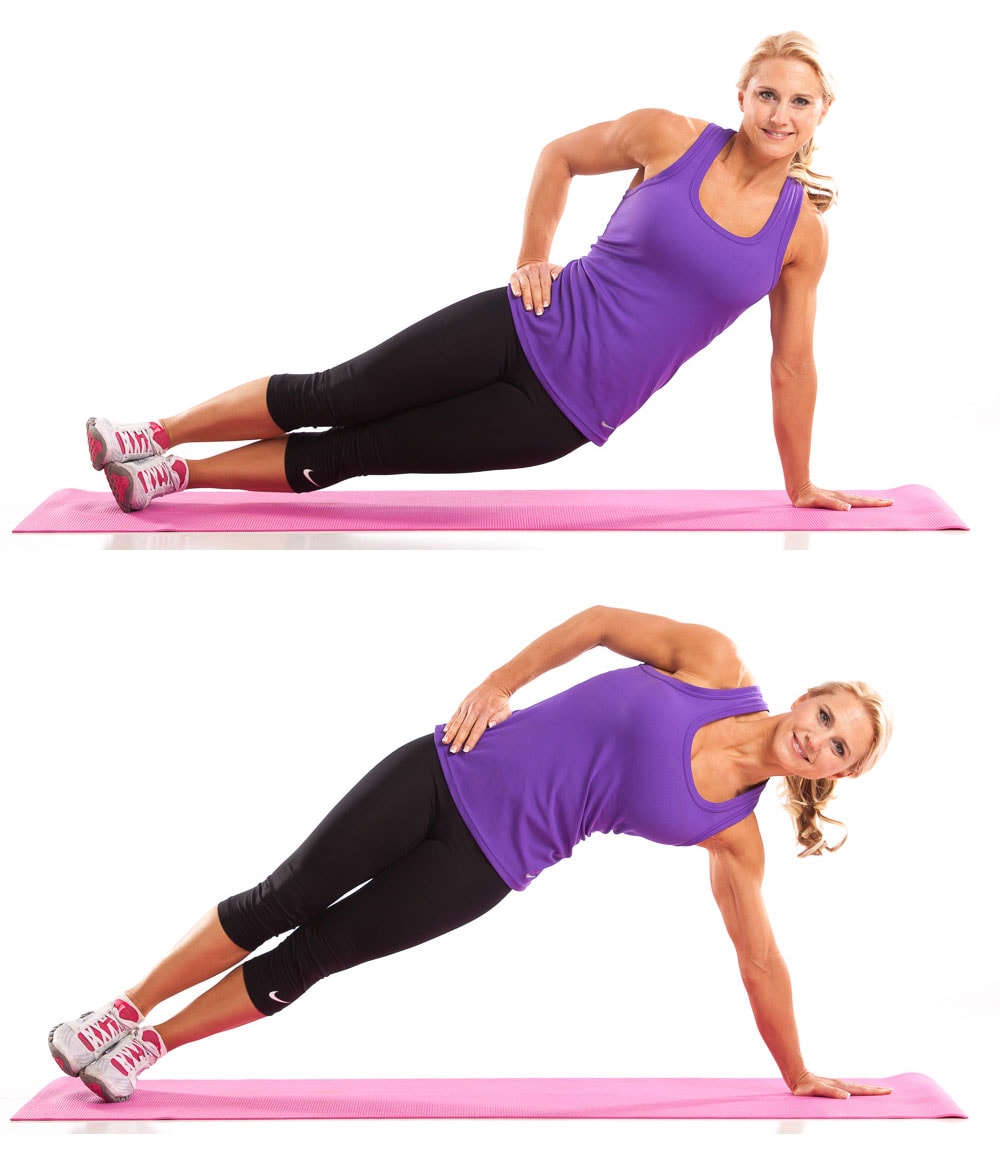
Julie Lohre demonstrates the Side Plank Pulses