

FITBODY Exercise Library · Abs
Toe Tap Exercise
The toe tap, also called the knee up exercise or toe tapping, is a way to engage your core without putting extra strain on your lower back. No equipment, no spinal flexion, and it can be done at home, at the gym, or anywhere you have floor space.
What Is the Toe Tap Exercise?
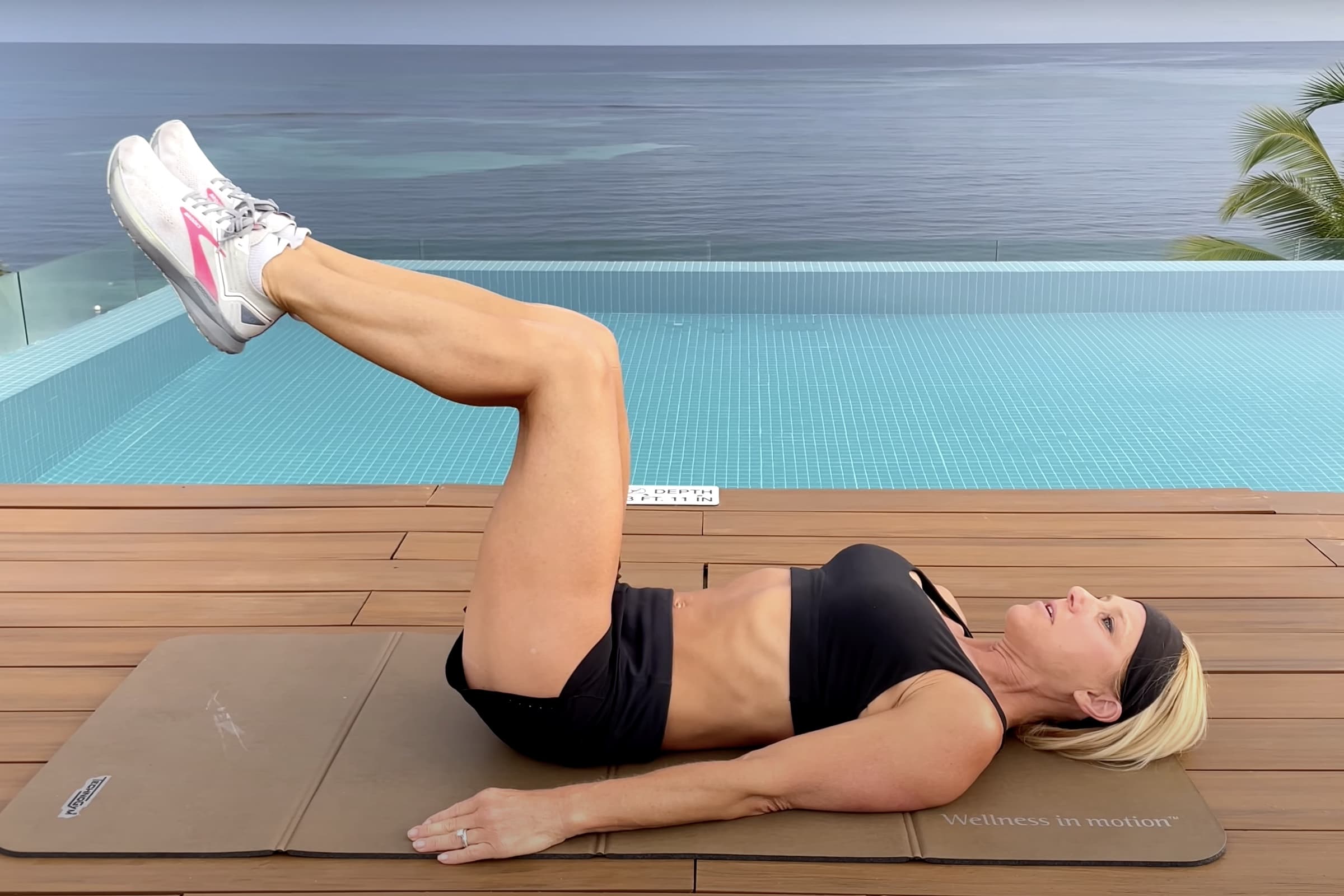
The toe tap, also known as the knee up exercise or toe tapping, is a floor based core movement performed from a reverse tabletop position. You lie on your back, bring your knees up over your hips, then slowly lower one foot at a time to tap the ground while the other knee holds its position.
What makes it different from most ab exercises is that your spine never flexes. There is no crunching, no sitting up, and no pulling on your neck. Your core works isometrically to stop your pelvis tipping and your lower back arching as each leg lowers. That is why it engages the core without putting extra strain on your lower back, and why it suits women who find crunches uncomfortable.
Because you need no equipment at all, this is a movement you can do at home, at the gym, or on the go.

How to Do the Toe Tap or Knee Up Exercise
Put a hand under your lower back for your first few sets. If you feel the pressure come off your hand as your foot lowers, your back has arched and your core has let go. That is your range, right there. Tap higher, or lower your foot less far, and build from a position you can actually hold. Most women can do far more reps than they can do good reps, and only the good ones count!

What Muscles Do Toe Taps Work?
The main movers are the rectus abdominis and the transverse abdominis, the deep stabilizer that wraps your midsection. Your obliques assist by resisting the slight rotation that wants to happen each time one leg moves independently, and your hip flexors and quadriceps control the lowering and lifting of each leg.
Worth understanding is that your abs here are working isometrically. They are not shortening to curl you up, they are holding your pelvis and spine steady against the pull of a moving leg. That is a different kind of core work than a crunch, and it is the reason this exercise is easier on the lower back. For a fuller picture, Cleveland Clinic has a good overview of the abdominal muscles.
See the full muscle breakdown
- Rectus abdominis: works isometrically to stop your pelvis tipping forward and your lower back arching as the leg lowers.
- Transverse abdominis: the deepest abdominal layer, bracing the midsection and holding internal pressure throughout.
- Internal and external obliques: resist the slight rotation created by moving one leg at a time.
- Hip flexors, including the iliopsoas: control the descent of the lowering leg and draw the knee back up to tabletop.
- Quadriceps: hold the knee at 90 degrees through the movement.
- Pelvic floor: works alongside the transverse abdominis as part of the deep core system.
Sets and Reps
Start conservatively. This exercise looks easy and the first time most women do it properly, with the back genuinely pressed down, they find five reps a side is plenty.
| Level | Sets | Reps per side |
|---|---|---|
| Beginner | 2 to 3 | 5 to 8 |
| Core strength | 3 | 10 to 12 |
| Advanced, straighter legs | 3 | 8 to 10 |
Depending on your experience level, start by completing 5 reps on each side for a total of 10, several times per week. To make the movement harder, slow down how quickly you move your knees or straighten your legs out further. Rest 30 to 45 seconds between sets. Progress by extending range and slowing tempo rather than adding reps, which is how progressive overload applies to a control based core exercise.
Variations and Modifications
Shortened Range Toe Tap
Lower your foot only partway rather than all the way to the floor. This is the correct starting point if your back lifts before your toe touches down. Build depth as your control improves rather than forcing the full range.
Slow Tempo Toe Tap
Take three full seconds to lower and three to return. Removing the speed removes any momentum and makes your core do all the work. This is my preferred way to make the exercise harder without changing anything else.
Straight Leg Toe Tap
Extend your legs further as you lower, closer to straight. The longer lever significantly increases the demand on your core and hip flexors. Only add this once you can complete the bent knee version with your back flat for every rep.
Dead Bug
Add the opposite arm reaching overhead as each leg lowers. This turns the toe tap into a full contralateral core exercise and is the natural next step once toe taps feel controlled.
Toe taps work well alongside planks for isometric core work, and as a gentler alternative to the lying leg raise if that one bothers your lower back.

Common Mistakes to Avoid
- Letting your lower back arch. The only mistake that really matters here. If your back peels off the floor as your foot lowers, your hip flexors are pulling on your lumbar spine instead of your core controlling the movement. Shorten the range.
- Moving too fast. Speed lets momentum do the work and hides the loss of position. Slow, deliberate taps beat quick ones every time.
- Dropping the foot rather than tapping. The toe should touch lightly and come straight back up. Letting the leg fall and bounce off the floor removes the control element entirely.
- Letting the other knee drift. The stationary knee should stay directly over its hip. If it drifts toward your chest or away from you, your core has stopped holding position.
- Holding your breath. Breathe steadily throughout. Breath holding is common on core work and it makes bracing harder, not easier.
Toe Taps in Pregnancy and Postpartum
This exercise comes up a lot in prenatal and postpartum contexts, and it is worth being careful and accurate about what is actually known.
Toe taps are a low intensity core movement that involves no spinal flexion and no loading, which is why they appear in many prenatal and postpartum programs. That said, exercise during pregnancy is highly individual, and lying flat on your back becomes less suitable for many women as pregnancy progresses. What is appropriate depends on your stage, your history, and your own body. Speak with your obstetric provider or a pelvic health physical therapist about what is right for you rather than relying on any general guidance, including mine.
On diastasis recti specifically, the common claim is that drawing-in exercises close the abdominal separation over time. The research does not support that. Ultrasound studies measuring the gap between the abdominal muscles have found that drawing-in maneuvers do not reduce that distance, and a 2023 randomised controlled trial concluded that head lifts and curl-ups do not worsen the separation and that women should not be discouraged from doing them. Research from Lee and Hodges did find that pre-activating the transverse abdominis produced a less distorted linea alba, which may improve how force transfers across the abdominal wall, so deep core work has a legitimate role. It simply is not the gap-closing exercise it is usually described as.
If you have diastasis recti, see a pelvic health physical therapist for an individual assessment. This is a condition that benefits from a program built for you rather than one exercise and a promise.
Toe Tap Exercise FAQs
What is the toe tap exercise?
The toe tap, also called the knee up exercise or toe tapping, is a floor based core exercise performed from a reverse tabletop position. You lie on your back, bring your knees up over your hips at roughly 90 degrees, then slowly lower one foot at a time to tap the ground while the other knee holds position. Your spine never flexes, so there is no crunching or sitting up. Your core works isometrically to stop your pelvis tipping and your lower back arching as each leg lowers.
What muscles do toe taps work?
The main movers are the rectus abdominis and the transverse abdominis, the deep stabilizer that wraps your midsection. Your obliques assist by resisting the slight rotation that happens each time one leg moves independently, and your hip flexors and quadriceps control the lowering and lifting of each leg. Your pelvic floor works alongside the transverse abdominis as part of the deep core system. The abs work isometrically here rather than shortening to curl you up, which is what makes this different from a crunch.
How many toe taps should I do?
Depending on your experience level, start by completing 5 reps on each side for a total of 10, several times per week. Beginners should use 2 to 3 sets of 5 to 8 per side, building toward 3 sets of 10 to 12 as your control improves. To make the movement harder, slow down how quickly you move your knees or straighten your legs out further rather than simply adding reps. Stop the set when your lower back starts lifting off the floor, not when you run out of reps.
Are toe taps good for lower back pain?
Many women find them more comfortable than crunches, because there is no spinal flexion and no loading involved. The exercise trains your core to hold your pelvis steady, which is the kind of control that supports the lower back. That said, back pain has many causes and no single exercise resolves all of them. The key is keeping your lower back pressed into the floor throughout. If your back arches as the leg lowers, you are loading your lumbar spine rather than training your core, and that is when discomfort shows up. If your back pain is persistent, get it assessed.
Are toe taps safe during pregnancy?
Toe taps are a low intensity core movement with no spinal flexion and no loading, which is why they appear in many prenatal programs. However, exercise during pregnancy is highly individual, and lying flat on your back becomes less suitable for many women as pregnancy progresses. What is appropriate depends on your stage, your history, and your own body. Speak with your obstetric provider or a pelvic health physical therapist about what is right for you rather than relying on general guidance from any website.
Do toe taps help diastasis recti?
Not by closing the separation, despite how often that is claimed. Ultrasound studies measuring the gap between the abdominal muscles have found that drawing-in maneuvers do not reduce that distance, and a 2023 randomised controlled trial found head lifts and curl-ups do not worsen it either, concluding that women should not be discouraged from doing them. Research from Lee and Hodges did find that pre-activating the transverse abdominis produced a less distorted linea alba, which may improve force transfer across the abdominal wall, so deep core work has a legitimate role. If you have diastasis recti, see a pelvic health physical therapist for an individual assessment.
References
- Lee, Diane, and Paul W. Hodges. “Behavior of the Linea Alba During a Curl-up Task in Diastasis Rectus Abdominis: An Observational Study.” Journal of Orthopaedic and Sports Physical Therapy, vol. 46, no. 7, 2016, doi.org/10.2519/jospt.2016.6536. Found that pre-activating the transverse abdominis produced a wider inter-rectus distance but substantially less distortion of the linea alba.
- Skaug, Kristina L., et al. “Curl-up Exercises Improve Abdominal Muscle Strength Without Worsening Inter-recti Distance in Women with Diastasis Recti Abdominis Postpartum: A Randomised Controlled Trial.” Journal of Physiotherapy, vol. 69, no. 3, 2023, sciencedirect.com/science/article/pii/S1836955323000528. Concluded that head lifts and curl-ups do not worsen inter-recti distance and that parous women should not be discouraged from performing them.
- Cleveland Clinic. “Abdominal Muscles: Anatomy & Function.” my.clevelandclinic.org/health/body/21755-abdominal-muscles.
Train With An Expert
Want a Plan Built Around You?
I’m Julie Lohre, an IFBB Fitness Pro and certified personal trainer and nutrition specialist. For more than 20 years I have helped women over 40 get stronger, leaner, and more confident through personalized online coaching built around their real lives.