FITBODY Exercise Library · Mobility & Yoga
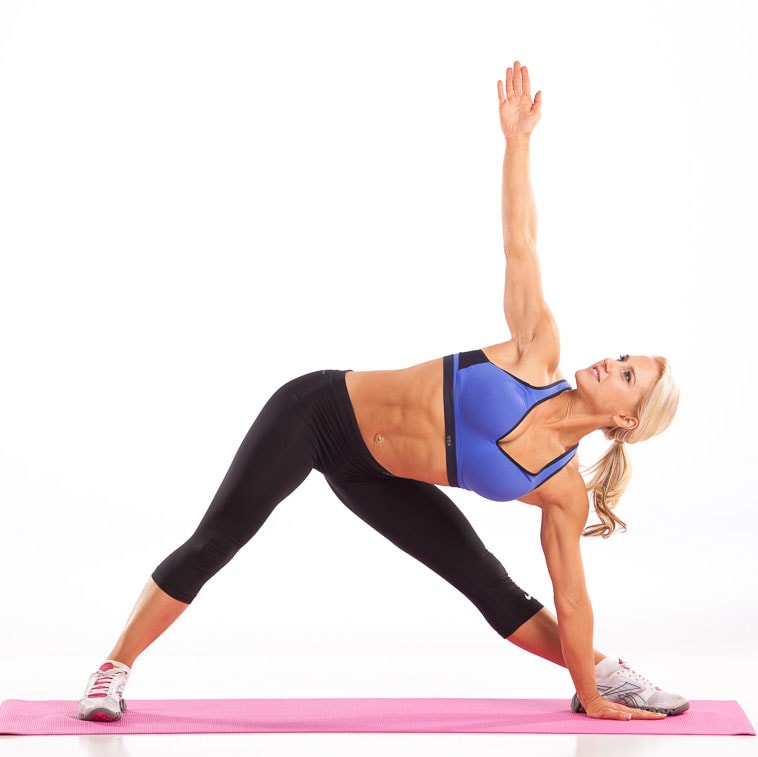
Extended Yoga Triangle
Extended yoga triangle, known in Sanskrit as Utthita Trikonasana, is a standing lateral stretch that opens the hamstrings, hips, and obliques while building leg strength and better balance. A simple pose that pays back generously in flexibility and posture.
How to Do Extended Yoga Triangle
Think of stretching between two panes of glass. Your chest and hips face forward, not down toward the floor. If your top shoulder starts rolling toward the ground, come up a few inches, use a block, and reset. Depth is not the goal here. Openness through the chest and length through the side body is where the real stretch lives.

What Extended Yoga Triangle Stretches
Extended yoga triangle opens the hamstrings, adductors, and outer hips while lengthening the obliques and stretching the shoulders and chest. Because the back leg is working hard to stay strong and the front leg supports the hinge, this pose also builds standing leg endurance and balance. Regular practice can noticeably improve hip mobility and posture, both of which pair well with the strength training approach I use inside my FITBODY Recomposition System. For a visual reference on the hamstring muscles, TeachMeAnatomy has a clear overview.
See the full muscle breakdown
- Hamstrings (front leg): lengthen through the hip hinge as you reach out and over the front leg.
- Adductors and inner thighs: open with the wide stance, especially on the front leg as the hip flexes.
- Obliques and side body: stretch through the top side as you reach the top arm overhead and lengthen the ribs.
- Spinal erectors: work isometrically to keep the spine long instead of collapsing forward.
- Quads and calves (both legs): hold both legs strong and stable, especially the back leg pressing into the floor.
- Shoulders and chest: open across the top as the arms reach in opposite directions.
How to Program Extended Yoga Triangle
Extended yoga triangle fits well as part of a warmup, inside a mobility or yoga flow, or as a cooldown after strength training. Hold, breathe, and focus on quality over depth every time.
| Use case | Sets per side | Hold time |
|---|---|---|
| Pre-training warmup | 1 | 3 to 5 breaths |
| Mobility or yoga flow | 2 to 3 | 5 to 8 breaths |
| Post-training cooldown | 1 to 2 | 5 to 10 breaths |
Focus on smooth, steady breathing throughout the hold. If you have a history of low-back issues, a recent hip injury, or any post-surgical restrictions, clear this and any hinging work with your physical therapist or physician before adding it in.
Variations and Modifications
Extended Triangle with a Block
Place a yoga block on the outside or inside of your front foot and rest your bottom hand on the block instead of reaching to the shin or floor. A smart option if your hamstrings are tight or your low back rounds when you reach down. Keep the chest open and the block does the work.
Triangle with Neck-Neutral Gaze
Instead of gazing up at your top hand, keep your neck neutral and gaze straight forward or gently down at the floor. A great option for anyone with cervical stiffness, neck issues, or balance concerns.
Wall-Supported Triangle
Practice with your back body lightly against a wall. The wall gives you feedback so your top shoulder does not roll forward and your chest stays open. Ideal for learning the pose and for anyone rebuilding balance and confidence in standing postures.
Revolved Triangle (Advanced)
A twisting variation where you reach the opposite hand toward the front foot and rotate the top arm up behind you. Reserved for practitioners with a strong base in standing poses and no active low-back or SI joint issues.
Related mobility and warmup movements can be found in the FITBODY Exercise Library.
Common Mistakes to Avoid
- Rounding the chest toward the floor. If your top shoulder rolls forward and your chest collapses down, you have turned this into a forward fold. Come up higher, use a block, and keep your chest open to the side.
- Locking the front knee. Keep a soft micro-bend at the front knee to protect the joint. Hyperextending under the load of the hinge is a common source of nagging knee pain.
- Overreaching for the floor. Depth is not the goal. If reaching your hand to the floor sacrifices your chest position, use a block or rest your hand higher on the shin.
- Holding your breath. Breathe smoothly the whole time. If you find yourself holding your breath, back off the depth of the pose until steady breathing returns.
Extended Yoga Triangle FAQs
What does extended yoga triangle stretch?
Extended yoga triangle primarily stretches the hamstrings, adductors, and outer hips, with a strong lengthening effect through the obliques and side body. Because the arms reach in opposite directions, the shoulders and chest also open across the top. The back leg works to stay strong and the front leg supports the hinge, so both legs build standing endurance alongside the flexibility work. It is one of the more well-rounded standing yoga poses for hip mobility, posture, and side body length.
How long should I hold extended yoga triangle?
Five to eight steady breaths per side is a strong dose for most women. If you are using triangle as a warmup, three to five breaths per side is enough to open the hamstrings and hips without pulling energy out of the training that follows. As part of a cooldown or dedicated mobility session, aim for five to ten breaths per side and let the pose deepen gradually as you exhale. Quality of breath matters more than time. If breathing gets shallow or tight, come out and reset.
Is triangle pose good for women over 40?
Yes, triangle pose is a very useful addition for women over 40 who want to protect hip mobility, hamstring flexibility, and standing balance as they age. The pose also builds the kind of standing leg endurance that pairs well with a strength-forward training program. Modifications matter, especially with a block under the bottom hand and a neutral neck if the top-hand gaze bothers you. Inside my FITBODY Lifestyle Coaching program, I choose mobility work based on each client’s history, current level, and goals.
What is the difference between extended triangle and revolved triangle?
Extended triangle is a lateral stretch. Both hips face the front of your mat, and you hinge sideways over the front leg with the top arm reaching up. Revolved triangle is a twisting variation. The opposite hand reaches down toward the front foot and the top arm rotates behind you, which changes the pose into a rotational stretch through the spine and hips. Revolved triangle is significantly more demanding on the low back and SI joint and is best reserved for practitioners with a strong base in the extended version first.
Can I do triangle pose with tight hamstrings?
Yes, this is one of the best poses for slowly opening tight hamstrings. The key is to use a block under your bottom hand instead of reaching for the floor, and to keep a soft micro-bend at the front knee. Tight hamstrings will pull your low back into a rounded position if you force the reach, which is where the pose starts to feel more like a punishment than a stretch. Height under the hand solves it. Over weeks of consistent practice, the hamstrings gradually let go and depth develops on its own.
References
- Ross, Alyson, and Sue Thomas. “The Health Benefits of Yoga and Exercise: A Review of Comparison Studies.” Journal of Alternative and Complementary Medicine, vol. 16, no. 1, 2010, pp. 3-12, https://doi.org/10.1089/acm.2009.0044.
Train With An Expert
Want a Plan Built Around You?
I’m Julie Lohre, an IFBB Fitness Pro and certified personal trainer and nutrition specialist. For more than 20 years I have helped women over 40 get stronger, leaner, and more confident through personalized online coaching built around their real lives.