
FITBODY Exercise Library · Arms
Tricep Kickbacks
Tricep kickbacks, also called dumbbell kickbacks, are one of the most straightforward ways to isolate and tone the back of the arms. I program them for women brand new to training and for advanced lifters alike.
What Is a Tricep Kickback?
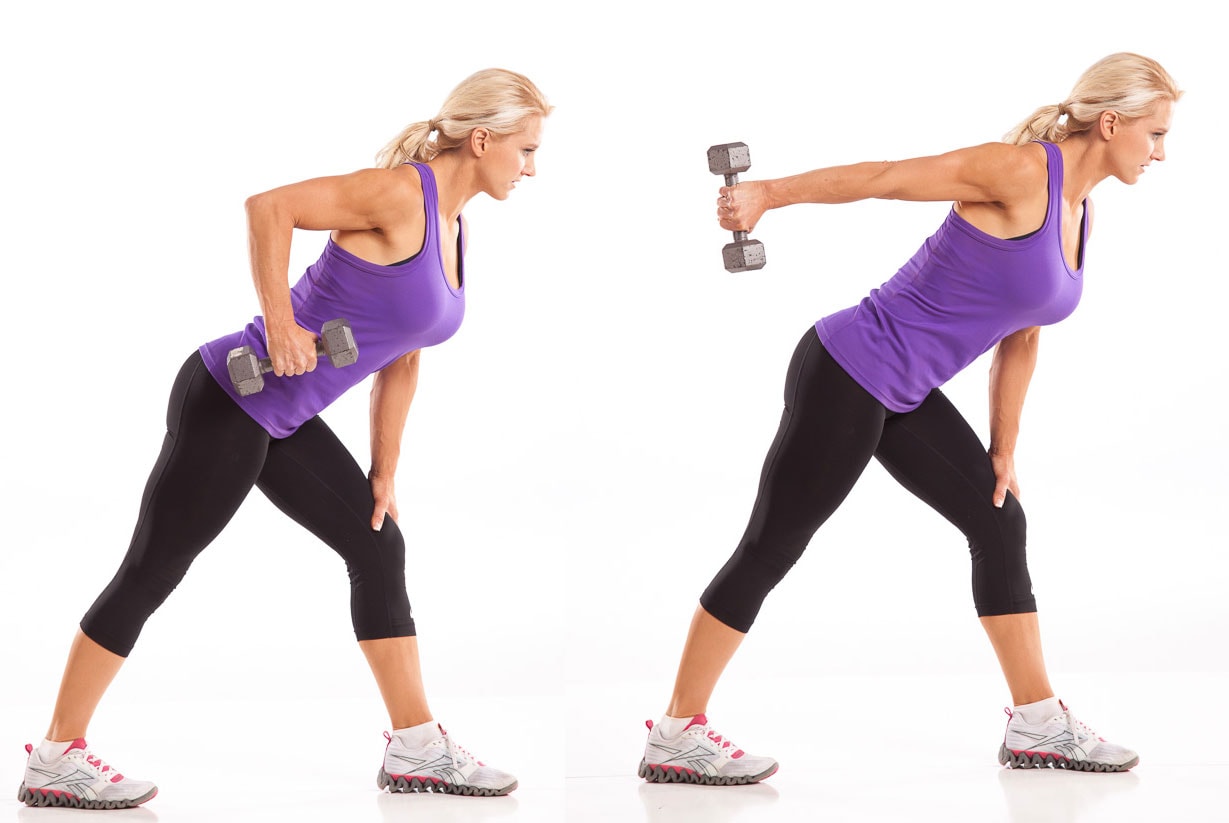
Tricep kickbacks, or dumbbell kickbacks, are an arm exercise where you hinge forward, fix your upper arm alongside your torso, and extend your forearm backward against a dumbbell. Everything moves at the elbow and nothing else, which is what makes it such a direct way to work the triceps.
I include this movement for women who are new to exercise as well as women who are more advanced, because it is such a straightforward way to isolate and tone the tricep muscles. If your goal is tightening the back of your arms, this is a good place to start.
How to Do Tricep Kickbacks
Watch your elbow, not the dumbbell. The second your elbow drops toward the floor as you extend, the movement stops being a tricep exercise and becomes a small swing. Get your elbow up in line with your shoulder before rep one and hold it there. If you cannot, the weight is too heavy, and on this exercise that happens at much lighter loads than most women expect.


What Muscles Do Tricep Kickbacks Work?
The triceps brachii is a three headed muscle at the back of the upper arm, made up of the long, medial, and lateral heads. The long head originates from the scapula while the medial and lateral heads originate from the humerus, and all three converge into a common tendon at the elbow. Their primary job is extending the forearm at the elbow, which is exactly what the kickback trains.
Your rear deltoids stabilize the shoulder while your arm is held up. Your core, including the rectus abdominis, obliques, and lower back, works isometrically to hold the hinged position so the focus stays on the tricep. The rhomboids and trapezius keep the shoulder blade retracted and stable.

See the full muscle breakdown
- Elbow extension: the primary function of the triceps. As you move your forearm from bent to straight, the triceps contract to extend the elbow.
- Long head: also helps stabilize the shoulder joint while you hold the hinged position. Note that with your arm back alongside your torso, the long head is in a shortened position rather than a stretched one.
- Rear deltoids: engaged to stabilize the shoulder as you maintain your arm at shoulder level.
- Rectus abdominis, obliques, and lower back: work isometrically to stabilize your torso and prevent unwanted movement.
- Rhomboids and trapezius: keep the shoulder blades retracted and stable, which supports proper alignment throughout.
Are Tricep Kickbacks Actually Effective?
Yes for what they do well, and it is worth being clear about the limits so you program them properly.
Kickbacks are excellent for learning to isolate the tricep, for training at home with minimal equipment, and for finishing an arm workout. Because the movement is so restricted, you feel exactly which muscle is working, which is genuinely useful for women new to training.
Where they fall short is building size. The long head of the tricep crosses both the elbow and the shoulder, so it only reaches a fully lengthened position when your arm is overhead. In a kickback your arm is behind you, which is the most shortened position of all. A 12 week study comparing overhead cable extensions against pushdowns found the overhead position produced substantially greater triceps growth, and a kickback shortens the long head even further than a pushdown does.
The practical answer is to use kickbacks alongside overhead tricep extensions rather than instead of them. Kickbacks for isolation and tone, overhead work for size.
Sets, Reps, and What Weight to Use
Aim for 3 sets of 10 to 15 repetitions with 30 to 60 seconds of rest between sets. This is an isolation exercise, so place it at the end of an arm or upper body day.
| Goal | Sets | Reps per side |
|---|---|---|
| Tone and definition | 3 | 10 to 15 |
| Building strength | 3 to 4 | 8 to 12 |
| Beginner, lighter weight | 2 to 3 | 12 to 15 |
On weight selection, here is the guidance I give my online coaching clients. If you are new to kickbacks or to strength training generally, begin light, anywhere from 2 to 5 pounds. That sounds low and it is deliberately low, because the arm position makes even small dumbbells feel substantial when your form is correct.
Your ability to perform the exercise with correct form matters more than the weight you use. If your form is compromised, or if you are swinging the weight rather than lifting it with controlled muscle action, reduce the weight. Choose a load that lets you complete your target sets and reps with good form while still feeling challenging by the last few reps. If the final 2 to 3 reps of each set are not challenging, it is time to go up.
Progress in small increments of 2 to 5 pounds. Mild muscle soreness is normal, but sharp pain or discomfort lasting more than a few days means you are lifting too heavy. Everyone is different, and fitness level, age, and overall strength all affect what is appropriate for you, which is exactly how progressive overload should be applied.
Variations and Modifications
Bench Supported Kickback
Place one knee and one hand on a flat bench with your torso parallel to the floor. Supporting your body removes the balance and lower back demand entirely, so all your attention goes to holding the elbow position. This is where I start most women.
Double Arm Kickback
Hinge forward with a dumbbell in each hand and extend both arms at once. It halves your set time and adds a real core and lower back demand since nothing is bracing you. Use lighter weights than you would single arm.
Band Tricep Kickback
Stand on a resistance band, hinge forward, and run the same movement. Band tension increases as you extend, which suits this exercise well because full extension is where you want the most resistance. A good travel or home option with no dumbbells needed.
Cable Kickback
Use a low cable pulley with a single handle. The cable provides constant tension through the whole range, unlike a dumbbell where the resistance drops off as you approach lockout. If you have gym access, this is the more effective version of the same movement.
Pair kickbacks with tricep pushdowns and overhead tricep extensions for a complete arm day.
Common Mistakes to Avoid
- Letting the elbow drop. The single most common error. Your upper arm stays fixed and level for the entire set. If the elbow sinks as you extend, you are swinging rather than pressing.
- Swinging the weight. Poor form reduces effectiveness and raises injury risk. Keep your back straight and every rep controlled, both on the way out and on the way back.
- Locking out the elbow. Do not fully lock the joint at extension. Keep a slight bend to protect the elbow.
- Choosing too much weight. Start lighter than feels right and master the form before progressing to heavier dumbbells. This is not an exercise where heavy loads pay off.
- Rounding the back. Hinge from the hips with a flat spine. If your back rounds to hold the position, use the bench supported version instead.
Tricep Kickback FAQs
What is a tricep kickback?
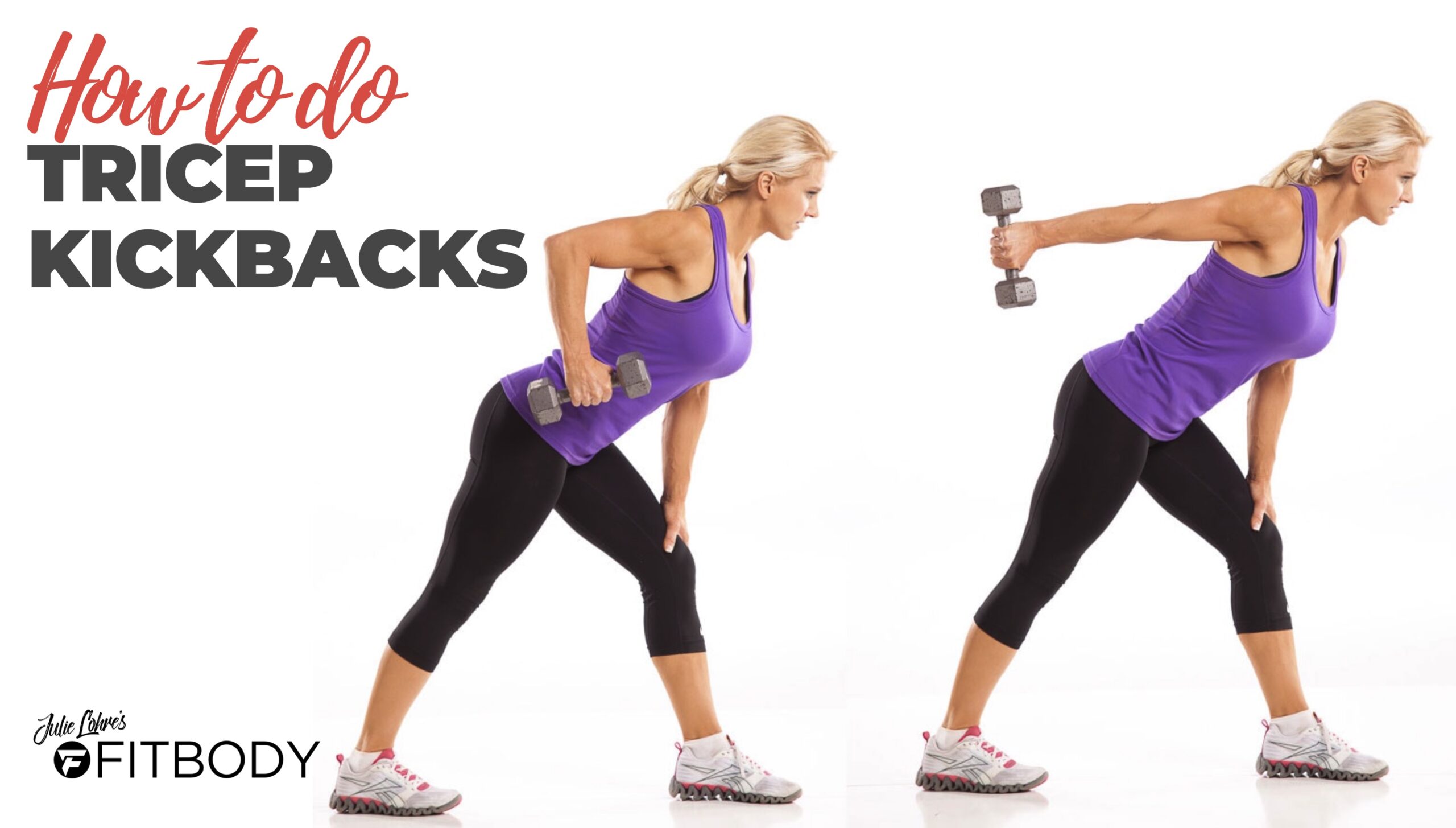
A tricep kickback, also called a dumbbell kickback, is an isolation exercise for the back of the upper arm. You hinge forward at the hips, fix your upper arm alongside your torso with the elbow at roughly 90 degrees, then extend your forearm backward until the arm is straight and parallel with the ground. Only the elbow joint moves, which is what makes it such a direct way to work the triceps. It needs just one dumbbell and can be done anywhere.
What muscles do tricep kickbacks work?
Tricep kickbacks target the triceps brachii, a three headed muscle at the back of the upper arm made up of the long, medial, and lateral heads. All three extend the forearm at the elbow, which is the movement the kickback trains. Your rear deltoids stabilize the shoulder while your arm is held up, and your core, obliques, and lower back work isometrically to hold the hinged position. Your rhomboids and trapezius keep the shoulder blade retracted throughout.
What weight should I use for tricep kickbacks?
If you are new to kickbacks or to strength training, start light, anywhere from 2 to 5 pounds. That sounds low, but the fixed arm position makes even small dumbbells feel substantial when your form is correct. Choose a weight that lets you complete your sets and reps with good form while the last 2 to 3 reps still feel challenging. If you are swinging the weight rather than lifting it with controlled muscle action, go lighter. Progress in small increments of 2 to 5 pounds as you get stronger.
Should tricep kickbacks hurt?
No, and it is important to distinguish between normal muscle fatigue and actual pain. Muscle fatigue feels like a burning sensation during or immediately after the exercise, which is normal and means the muscle is working, and it should subside shortly after you finish. Sharp, stabbing, or persistent pain is different and can indicate improper technique, too much weight, or a pre-existing condition being aggravated by the movement. If you feel that kind of pain, stop and check your form or speak with a fitness or medical professional.
Are tricep kickbacks effective?
They are effective for isolating and toning the triceps, learning the mind to muscle connection, and training at home with minimal equipment. Where they are weaker is building size. The long head of the tricep crosses the shoulder, so it only fully lengthens when your arm is overhead, and a kickback places the arm behind you in the most shortened position of all. Research found overhead extensions produce substantially more triceps growth than pushdowns, and kickbacks shorten the long head even further. Use them alongside overhead work rather than as your only tricep exercise.
Can I do tricep kickbacks without dumbbells?
Yes. A resistance band works well, and in some respects better. Stand on the band, hinge forward, and run the identical movement. Band tension increases as you extend, which suits this exercise because full extension is exactly where you want the most resistance, whereas a dumbbell gets easier near lockout. A low cable pulley is another option if you train at a gym, since it provides constant tension through the whole range.
References
- Maeo, Sumiaki, et al. “Triceps Brachii Hypertrophy Is Substantially Greater After Elbow Extension Training Performed in the Overhead Versus Neutral Arm Position.” European Journal of Sport Science, vol. 23, no. 7, 2023, pp. 1240 to 1250, doi.org/10.1080/17461391.2022.2100279. Across 12 weeks in 21 adults, training with the shoulder flexed overhead produced substantially greater triceps hypertrophy than training with the arm at the side.
- Tiwana, Manpreet S., et al. “Anatomy, Shoulder and Upper Limb, Triceps Muscle.” StatPearls, NCBI Bookshelf, ncbi.nlm.nih.gov/books/NBK536996.
Train With An Expert
Want a Plan Built Around You?
I’m Julie Lohre, an IFBB Fitness Pro and certified personal trainer and nutrition specialist. For more than 20 years I have helped women over 40 get stronger, leaner, and more confident through personalized online coaching built around their real lives.