FITBODY Exercise Library · Plyometrics
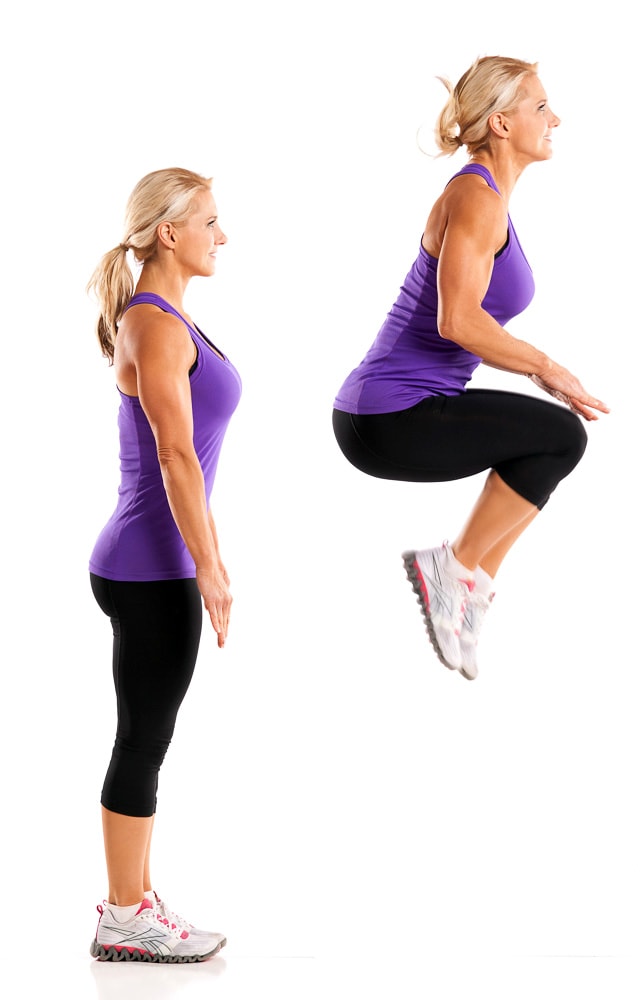
Tuck Jumps
Tuck jumps are an advanced bodyweight plyometric that build explosive lower-body power, athletic conditioning, and coordination when programmed with control and clean landing mechanics.
How to Do Tuck Jumps
Land soft. If I can hear your feet hit the floor across the room, you are landing too hard. Bend your knees, sink into the landing, and think about absorbing the impact through your hips and thighs. Quiet feet mean stronger tendons, better mechanics, and fewer nagging aches over time.

What Muscles Do Tuck Jumps Work?
Tuck jumps are a lower-body dominant plyometric that primarily load the quadriceps, with strong contribution from the glutes, calves, and hip flexors. The trunk works hard as well, resisting rotation and stabilizing under repeated impact. Because the demand is explosive and reactive, tuck jumps pair well with strength work inside my FITBODY Recomposition System.
See the full muscle breakdown
- Quadriceps (rectus femoris, vastus lateralis, medialis, intermedius): power the vertical drive out of the ground and control the descent on landing.
- Gluteus maximus: extends the hip at takeoff and helps absorb load on the way down.
- Gastrocnemius and soleus: ankle plantar flexion pushes you off the floor and cushions the landing.
- Iliopsoas and hip flexors: pull the knees up toward the chest at the top of the jump.
- Core (rectus abdominis, obliques, transverse abdominis): keeps the trunk stacked and stable under repeated impact.
Sets and Reps
Tuck jumps are high-intensity, so quality outranks volume every time. Program them early in a session, after a proper warm-up, with generous rest between sets. Stop the set the moment your landings turn loud or your knees lose their line.
| Goal | Sets | Reps |
|---|---|---|
| Power and athletic performance | 3 to 4 | 5 to 8 |
| Conditioning and interval work | 3 to 4 | 20 to 30 seconds |
| Beginner or returning to plyos | 2 to 3 | 3 to 5 |
Rest 60 to 90 seconds between sets for power work, 30 to 60 seconds for conditioning. Keep tuck jumps out of high-fatigue positions at the end of a lifting session, since sloppy landings under fatigue are where knees and ankles get cranky.
Variations and Modifications
Squat with Knee Raise (Low Impact)
Perform a bodyweight squat, then instead of jumping, drive one knee up toward your chest as you stand tall. Alternate legs. Same hip flexor and quad demand without the landing impact, which makes this a strong option if your joints are not ready for plyometrics yet.
Squat Jump
A cleaner entry point to jumping. You still explode up out of a quarter squat, but you do not pull the knees to chest at the top. Master soft, controlled landings on squat jumps before layering the tuck.
Tuck Jump to Box or Bench
Jump up onto a low box or sturdy bench, tucking the knees at the peak. Because you land higher than you started, the impact through your ankles and knees drops significantly. This is a smart intermediate step when you want the tuck pattern without the full landing load.
Broad Tuck Jump (Advanced)
Combine horizontal and vertical drive by jumping forward and pulling your knees to chest at the top. Reserved for athletes with clean landing mechanics, strong single-leg strength, and no active knee, ankle, or hip issues.
Related plyometric and lower-body movements in the FITBODY Exercise Library include squat jumps, box jumps, and broad jumps.
Common Mistakes to Avoid
- Loud, heavy landings. Every landing should be nearly silent through the ankle, knee, and hip. Loud feet mean you are dropping instead of absorbing.
- Knees not reaching the chest. If your knees only rise to hip level, the movement turns into a small hop with no real tuck. Aim for knees toward chest at the top.
- Rounding through the trunk. Fold at the hips, not the spine. If your chest caves forward as you tuck, you lose power and load the low back.
- Chasing reps under fatigue. Set a controlled rhythm and stop the set the moment quality drops. Sloppy tuck jumps are where injuries happen.
Tuck Jump FAQs
What muscles do tuck jumps work?
Tuck jumps primarily work the quadriceps, glutes, calves, and hip flexors, with strong core involvement to stabilize the trunk under impact. The quads and glutes power the vertical drive out of the ground, the calves push you off the floor and cushion the landing, and the hip flexors pull the knees up toward the chest at the top of the jump. Because the movement is reactive and high-force, the connective tissue around the ankles, knees, and hips is also strongly loaded.
Are tuck jumps a good exercise for women over 40?
Tuck jumps can be a strong addition for women over 40 who already have a base of strength training and clean landing mechanics, because plyometric training supports power, athletic capacity, and bone loading. That said, they are not a starter exercise. If your knees, hips, or ankles feel cranky, or you have not been training consistently, start with squat jumps, tuck jumps onto a box, or the low-impact squat with knee raise variation and progress from there. Inside my FITBODY Lifestyle Coaching program, I choose plyometrics based on each client’s joint history, current training level, and goals.
How many tuck jumps should I do?
For power development, 3 to 4 sets of 5 to 8 clean tuck jumps is plenty. For conditioning inside an interval-style workout, 3 to 4 rounds of 20 to 30 seconds with adequate rest works well. Beginners returning to plyometric work should start with 2 to 3 sets of 3 to 5 reps and build from there. The moment your landings turn loud or your knees stop tracking cleanly over your feet, end the set. Quality reps drive results, sloppy reps drive nagging injuries.
What is the difference between tuck jumps and squat jumps?
Both are vertical bodyweight plyometrics, but the demand is different. A squat jump drops into a quarter squat and explodes straight up with no knee tuck at the top. A tuck jump adds a hard, active pull of both knees toward the chest at the peak of the jump, which raises the intensity, the coordination demand, and the landing impact. Squat jumps are the smart place to build clean landings and comfortable jump mechanics before layering in the tuck.
Can I do tuck jumps if I have bad knees?
If your knees are actively bothering you, tuck jumps are not the right choice. The repeated high-impact landings and the demand on the quadriceps and patellar tendon can flare things up quickly. Better options while you rebuild are the squat with knee raise for a low-impact version, and box jumps or step-ups to load the same muscles without the aggressive landing. If knee pain has been ongoing, work with a qualified physical therapist to identify the underlying cause before layering plyometric training back in.
References
- Slimani, Maamer, et al. “Effects of Plyometric Training on Physical Fitness in Team Sport Athletes: A Systematic Review.” Journal of Human Kinetics, vol. 53, 2016, pp. 231-247, https://doi.org/10.1515/hukin-2016-0026.
Train With An Expert
Want a Plan Built Around You?
I’m Julie Lohre, an IFBB Fitness Pro and certified personal trainer and nutrition specialist. For more than 20 years I have helped women over 40 get stronger, leaner, and more confident through personalized online coaching built around their real lives.