
FITBODY Exercise Library · Back
Renegade Row and Dumbbell Plank Rows
The renegade row is one of the most efficient back exercises you can do at home with nothing but a pair of dumbbells, and the dumbbell plank row is the version I start most women on before adding the pushup.

How to Do a Renegade Row
Renegade rows were first made popular in CrossFit, and what I like most about them is that they are a genuinely effective back exercise you can do at home with just dumbbells. If your back work has been limited to cable machines like lat pulldowns, straight arm cable pulldowns, or seated rows, this is a very different and very efficient way to train.
If your hips are swinging, widen your feet before you lighten the dumbbells. Stance width buys you more stability than weight reduction does, and it lets you keep training the row instead of fighting the plank.

Renegade Row vs Plank Row
Both the dumbbell plank row and the renegade row start in the same body position and both use your whole body to drive the rowing motion. The difference is the pushup. With a renegade row, you add a full pushup immediately after the rowing portion, which makes it the advanced version of the dumbbell plank row.
| Dumbbell Plank Row | Renegade Row | |
|---|---|---|
| Movement | Row right, row left | Row right, row left, pushup |
| Main demand | Back and anti-rotation core | Back, chest, triceps, core |
| Best for | Learning the position, building back strength | Adding pressing volume and conditioning |
| Level | Beginner to intermediate | Intermediate to advanced |
Start with the plank row. Once you can complete all your reps without your hips rotating, add the pushup.
What Muscles Do Renegade Rows Work?
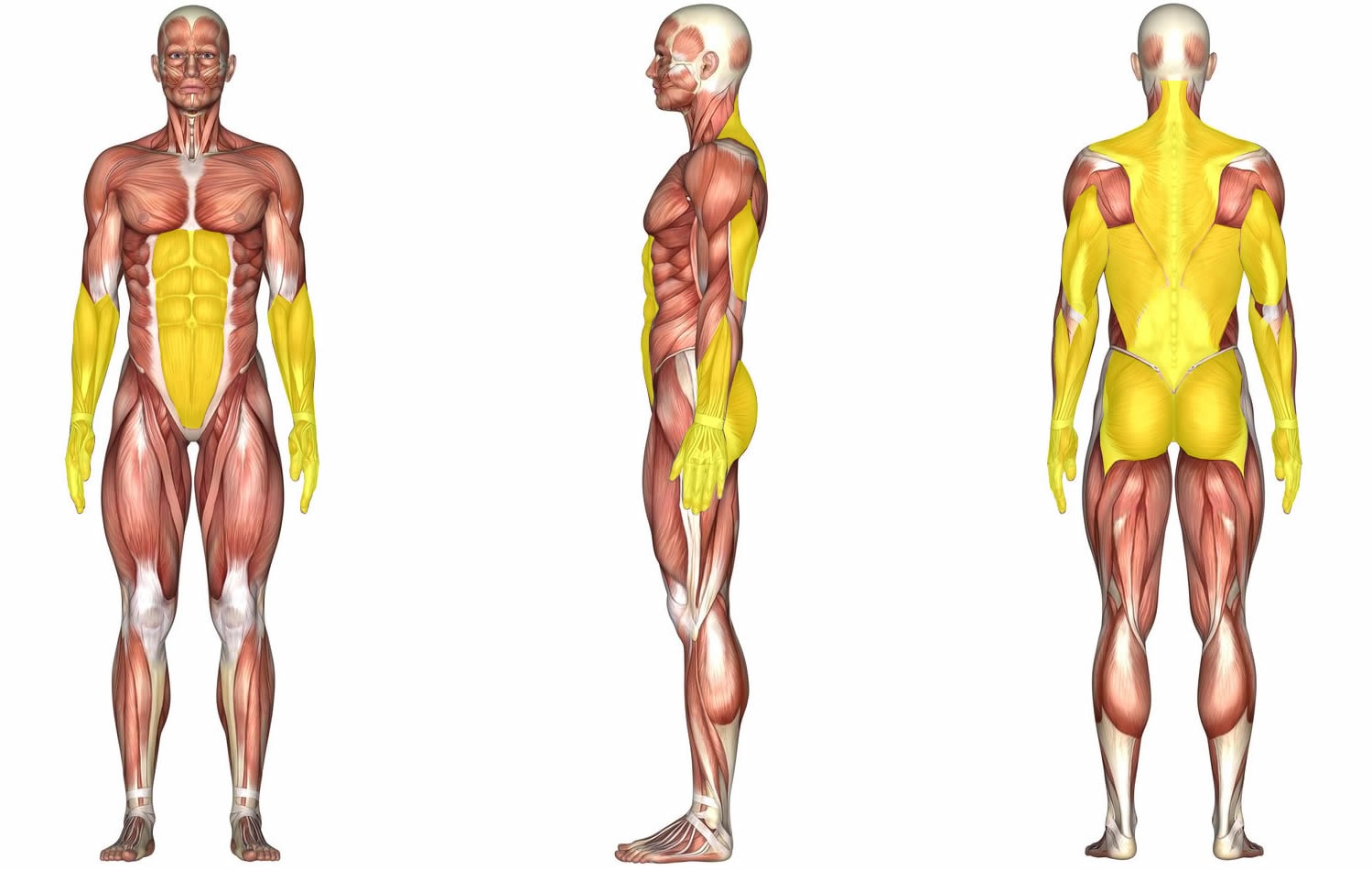
The renegade row is a compound movement that strengthens your back while working nearly everything else, from your upper body through your core and into your glutes as you hold the plank. It builds the trapezius, rhomboids, and latissimus dorsi as the primary movers, with the glutes, triceps, and biceps supporting. If you want to see how the back muscles layer together, that breakdown is useful context. Compound pulls like this one are a cornerstone of body recomposition, because they let you train a lot of muscle in very little time.
See the full muscle breakdown
- Latissimus dorsi: the largest muscle of the upper body, driving the pulling motion as your elbow travels back.
- Trapezius and rhomboids: retract the shoulder blade at the top of each row and build the upper back posture most women want.
- Obliques: work hardest here, resisting the twist that wants to happen every time you lift one hand off the floor.
- Rectus abdominis and erector spinae: hold the trunk rigid so the pull comes from your back and not from your lower spine.
- Glutes: squeeze to keep the hips from sagging and to hold the straight line from head to heels.
- Triceps and shoulders: stabilize the supporting arm and do the pressing work on the pushup portion.
- Biceps: assist the pull as the elbow bends.
Sets and Reps
Because this movement asks your core to work the entire time, quality falls off faster than it does on a bench supported row. Choose a weight you can control for every rep on both sides, and count one row per arm rather than one full cycle.
| Goal | Sets | Reps per side |
|---|---|---|
| Strength and shape | 3 to 4 | 8 to 10 |
| Core control and endurance | 2 to 3 | 10 to 12 |
| Beginner or returning | 2 to 3 | 6 to 8 |
Rest 60 to 90 seconds between sets. Place renegade rows early in your back or full body workout while your core is fresh. Add weight only once your hips stay level for every rep, which is exactly how progressive overload should work on a stability driven exercise.
Variations and Modifications
Dumbbell Plank Row
Drop the pushup and row only. This is where I start most women, and it is a complete back exercise on its own. Stay here until your hips stop rotating.
Knee Supported Plank Row
Set your knees on the floor to shorten the lever. This takes a large amount of load off the core while still training the row, and it is a good option if your wrists or shoulders are complaining in the full plank.
Narrow Stance Renegade Row
Walk your feet closer together to make the anti-rotation demand much harder without touching the dumbbells. This is the progression I use before adding weight, since it builds control rather than just load.
Chest to Floor Renegade Row
Bring your chest all the way down to the floor on the pushup portion. This is the most advanced version and should only come after the standard renegade row feels controlled.
If you are building a back day around this, pair it with lat pulldowns and gorilla rows, and work on your plank separately if holding the position is the limiting factor.
Common Mistakes to Avoid
- Letting the hips rotate. If your hip lifts every time you row, you are training rotation instead of resisting it. Widen your feet, slow the pull down, or drop to the plank row version.
- Going too heavy. The dumbbells that feel right for a bench supported row are usually too heavy here. The plank sets the ceiling, not your back strength.
- Letting the stomach sag. A sagging midsection puts the load into your lower back. Squeeze your glutes and brace before the first rep, not after.
- Rushing the reps. Speed hides poor position. Pull slowly, pause briefly at the top, and lower under control so your back is actually doing the work.
Renegade Row FAQs
What is the difference between a plank row and a renegade row?
The difference is the pushup. A dumbbell plank row is a row on each side from a high plank position, while a renegade row adds a full pushup immediately after rowing both sides. Both start in the same position and both demand full body stability, but the renegade row is the advanced version because it adds pressing work and conditioning on top of the pull. In my coaching, women start with the plank row and add the pushup once their hips stay level through every rep.
What muscles do renegade rows work?
Renegade rows primarily build the latissimus dorsi, trapezius, and rhomboids, which are the muscles that create upper back strength and better posture. The obliques and the rest of the core work continuously to resist the rotation that happens every time one hand leaves the floor. Your glutes, triceps, biceps, and shoulders all contribute as stabilizers, and the pushup portion adds direct chest and triceps work. That combination is why this single exercise covers so much ground in a short workout.
How much weight should I use for renegade rows?
For most women I recommend starting with 10 or 15 pound dumbbells and adjusting from there. Your plank position determines the right weight, not your back strength, so a dumbbell that feels light on a bench supported row can still be too heavy here. If your hips rotate or your midsection sags, the weight is too heavy regardless of how the pull feels. Progress by narrowing your stance or adding reps before you reach for heavier dumbbells.
Why do my hips twist when I do renegade rows?
Hip rotation is the most common issue with this exercise and it usually means the anti-rotation demand is outpacing your current core strength. The fastest fix is widening your feet, since a wider base makes the position far more stable without changing the row itself. Slowing the pull down and bracing your midsection before the first rep also helps considerably. If it still happens, drop the pushup and work the plank row until you can complete all your reps with square hips.
Are renegade rows a good exercise for women over 40?
Renegade rows are an excellent option for women over 40 because they build upper back strength and core stability at the same time, and they need nothing more than a pair of dumbbells at home. The one caution is wrist and shoulder comfort, since the position loads both while you hold the dumbbells. If your wrists bother you, set your knees down or use hex dumbbells with a neutral grip on a firm surface. Start with the plank row version, keep the weight modest, and progress by improving position before adding load.
References
- Fenwick, Chad M. J., Stephen H. M. Brown, and Stuart M. McGill. “Comparison of Different Rowing Exercises: Trunk Muscle Activation and Lumbar Spine Motion, Load, and Stiffness.” Journal of Strength and Conditioning Research, vol. 23, no. 5, 2009, pp. 1408 to 1417, doi.org/10.1519/JSC.0b013e3181b07334. Single arm rowing was found to challenge the trunk muscles’ ability to resist twisting, which is the same demand a plank row places on the core.
- Saeterbakken, Atle Hole, et al. “The Effect of Performing Bi- and Unilateral Row Exercises on Core Muscle Activation.” International Journal of Sports Medicine, vol. 36, no. 11, 2015, pp. 900 to 905, doi.org/10.1055/s-0034-1398646. Rowing one arm at a time produced substantially higher external oblique activity than rowing with both arms, supporting the core benefit of unilateral rowing.
Train With An Expert
Want a Plan Built Around You?
I’m Julie Lohre, an IFBB Fitness Pro and certified personal trainer and nutrition specialist. For more than 20 years I have helped women over 40 get stronger, leaner, and more confident through personalized online coaching built around their real lives.