Most Effective HIIT Workouts for Women
(High Intensity Interval Training)
High intensity interval training is the perfect answer for fitting exercise into our busy lives. Between the demands of work, school, family, friends and kids, there are only so many hours in the day what is a busy woman to do? Finding the time to get your workouts in can just seem impossible. I tell my online training clients that I want their fitness goals to work with their lives… not against it! Who needs one more time consuming thing to do in a day? Standard bodybuilding type workouts with 3 sets of 8 reps where you rest 2-3 mins between sets are becoming a thing of the past. Hitting the treadmill at a low intensity for an hour of fast walking in the ‘fat burning zone’ not only takes way too much time, it does not produce the incredible results that you get when you include HIIT training into your routine.
CrossFit has made popular a new style of high intensity workouts that all of us can learn from. From EMOM (every minute on the minute) workouts to metabolic training that conditions your cardiovascular system and muscles alike, this type of interval training where you alternate between periods of high intensity and periods of low intensity is on the rise for a very good reason.
Julie Lohre
Women's Fitness Expert & Online Personal Trainer
FITBODY MAGAZINE FOR WOMEN
The Latest in Fitness & Nutrition for Real Women!
What is a HIIT Workout?
High intensity interval training is the term used for metabolic endurance workouts that alternate between all out, very challenging periods of difficult training and recovery periods where you lower your intensity bringing your heart rate down. The beauty of this workout method is that it allows you to pack more movement, more challenge and more training into a short period of time.
Often thought of as heart rate training, the best HIIT workouts alternates between short work intervals at 85 to 95 percent of your max heart rate and rest periods that bring you down to 60 to 65 percent max heart rate. One of my favorite aspects about high intensity interval training for women is not just that it allows you to be burning significantly more calories per minute of exercise, it stokes your metabolism and you see great calorie burns in the hours after training.
HITT has been used in the past more often with cardiovascular training to help build speed and agility. Marathon runners love this type of periodized training and notice that over time, they are able to increase their speeds on the most difficult portion of their runs. It has everything to do with anaerobic efficiency. Recovery times can be come shorter and shorter without decreasing the overall work load. In the long run, you become more efficient, faster and that 1 mile run time or your 5k time decreases. And for a long distance runner like a marathoner, these time savings add up to new pr’s come race time. Not until recently have the best online trainers taken that methodology outside the cardio realm and applied it to weight training or body weight training. By manipulating your heart rate zones, you can work both your muscles and your cardio vascular system with high intensity interval training providing an incredible calorie burn with muscle strengthening and development.
Where Women Should Start with HIIT Training.
When you are beginning high intensity training, you need to start with your heart rate. If you have a great heart rate monitor like a FITBIT or Garmin, that is ideal. Otherwise, you can take your own pulse for 15 seconds, multiple it by 4 to get your 1 minute pulse rate periodically through the workout. Start first by determine your maximum heart rate (MHR) and the ideal ‘low intensity’ and ‘high intensity’ ranges.
How to Determine your Max Heart Rate (MHR)
The Mayo Clinic has a nice and simple methodology to help determine your max heart rate along with the most effective target heart rate zones for HIIT training. According to the Mayo Clinic, “The basic way to calculate your maximum heart rate is to subtract your age from 220. For example, if you're 45 years old, subtract 45 from 220 to get a maximum heart rate of 175. This is the maximum number of times your heart should beat per minute during exercise.”
From there, we can calculate your personal low and high zones for each interval. I prefer for the low intensity period to be at 60-65% of that MHR. You simply take that max heart rate and multiply it by .6 and .65 to get the low end of your target range. To get the high end of your range, multiply it by .85 and .95.
For our 45 year old example:
60-65% Low Intensity Zone = 105 - 114 beats per minute
85-95% High Intensity Zone = 149 - 166 beats per minute
Here are 5 of my most effective high intensity interval training workouts that you can start including in your training schedule right away!
FITBODY HIIT Cardio Workouts
These workouts will help you alternate back and forth between those heart rate zones very effectively. If you find that you are outside the zone, whether above or below you will want to modify the exercises to adjust your hr. You can do that either by lengthening the rest periods or increasing the reps for the higher intensity exercises.
Upper Body HIIT Workout
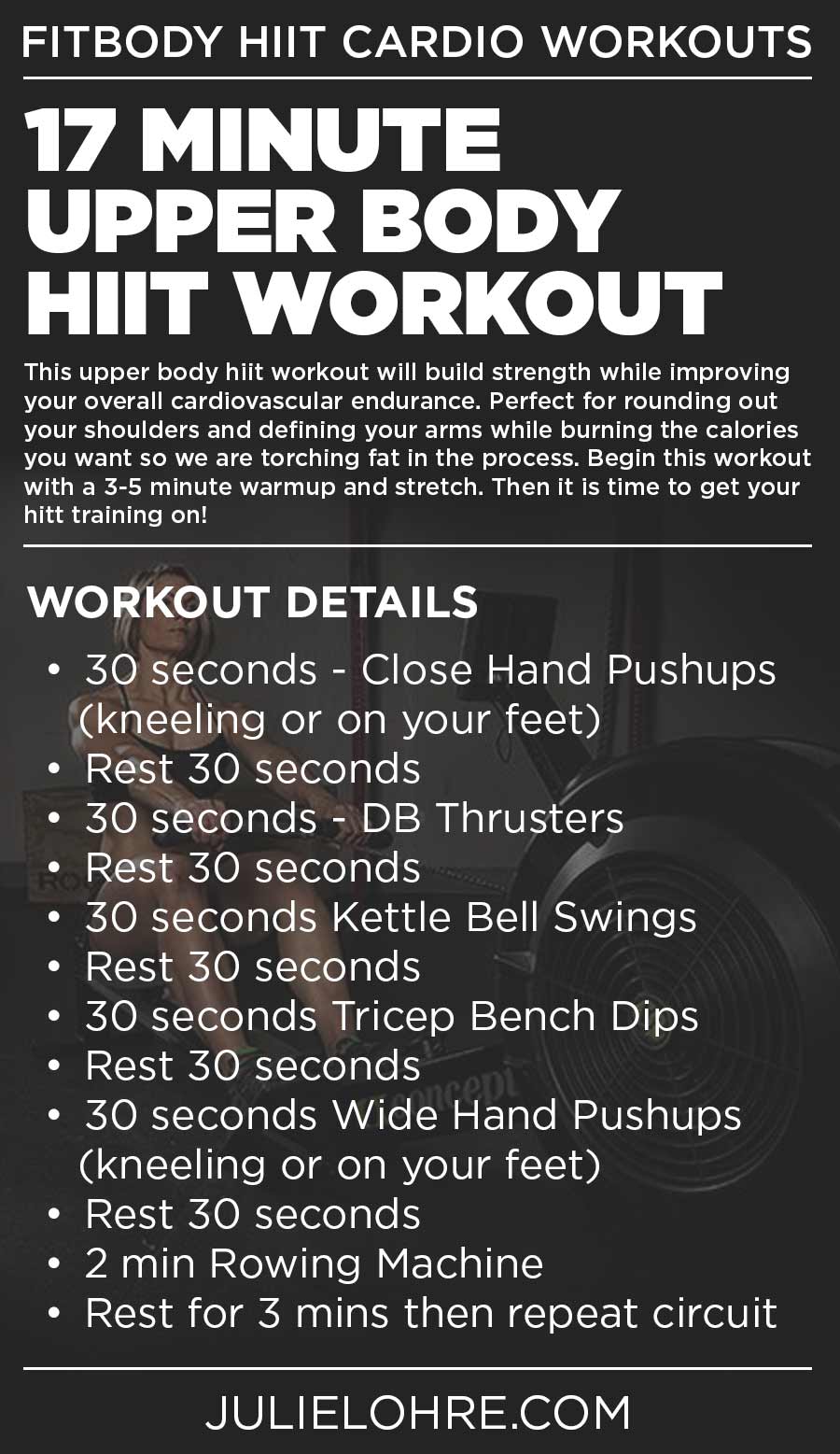
This upper body hiit workout will build strength while improving your overall cardiovascular endurance. Perfect for rounding out your shoulders and defining your arms while burning the calories you want so we are torching fat in the process. Begin this workout with a 3-5 minute warmup and stretch. Then it is time to get your hitt training on!
- 30 seconds - Close Hand Pushups (kneeling or on your feet)
- Rest 30 seconds
- 30 seconds - DB Thrusters
- Rest 30 seconds
- 30 seconds Kettle Bell Swings
- Rest 30 seconds
- 30 seconds Tricep Bench Dips
- Rest 30 seconds
- 30 seconds Wide Hand Pushups (Kneeling or on your feet)
- Rest 30 seconds
- 2 min Rowing Machine
- Rest for 3 mins then repeat the circuit
Total time: 7 mins per circuit
HIIT Ab Workout
While six pack abs take time, if you are ready to work hard you can get an amazingly efficient hiit ab workout in and start your way toward carving out that ab definition! I am always amazing at how sore my abs feel the next day when I complete this type of interval ab work. What I love is that by alternating isometric exercises like plank with just the right high energy core work and some twisting you can keep your heart rate up. That helps you shape the muscles while losing that layer of abdominal fat that tends to hide even the more chiseled six pack abs! Best part is you can do this 20 min ab workout at home or anywhere really with no equipment.
Always begin with a strong 3-5 min warmup to get your heart pumping. Then the real work begins:
Complete each of the exercises below for 30 seconds (start your timer when you first move from the starting position) Rest for 30 seconds between each. Repeat the total circuit 2 times depending on your experience level. Trust me, your abs will be on fire!
- Russian Twists
- Upward Hip Thrusts
- Lying Leg Raises
- Plank Position Knee Drives
- Bicycle Crunch
- Boat to Bow Pose
- Mountain Climbers
- Side Plank Pulses
- Butterfly Situps
- Plank Hand to Elbows

HIIT Leg Workout
Most women want to have lean, defined legs but getting those is definitely a process. You first have to focus on strengthening and building with exercise that work your full legs & butt. The quads, hamstrings, glutes and calves all need to be worked. Secondly, to really see the definition and tone, you need to reduce body fat across your whole body. That comes through both a clean eating and a good diet along with high intensity workouts specifically targeted at the legs.
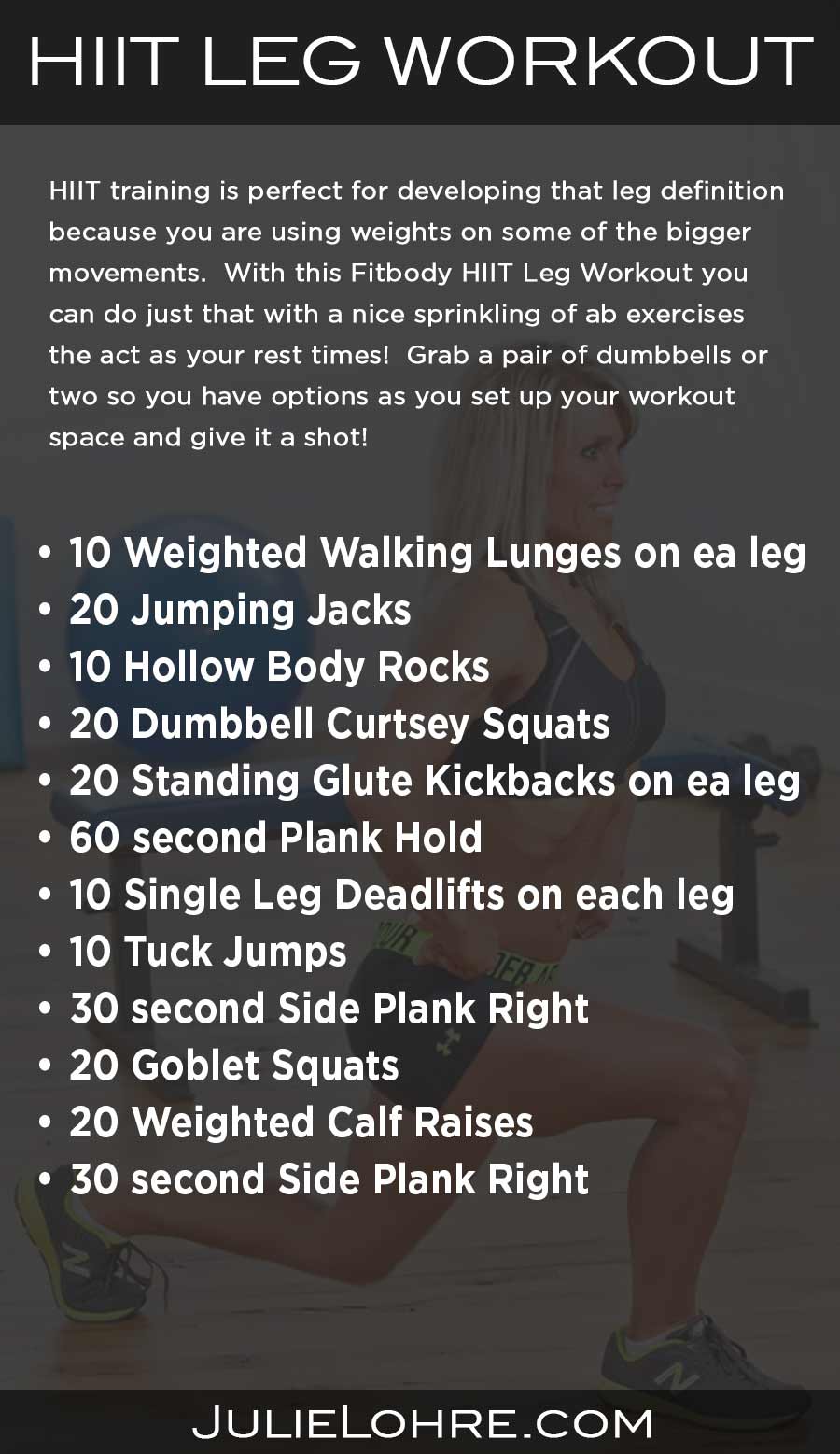
HIIT training is perfect for developing that leg definition because you are using weights on some of the bigger movements. With this Fitbody HIIT Leg Workout you can do just that with a nice sprinkling of ab exercises the act as your rest times! Grab a pair of dumbbells or two so you have options as you set up your workout space and give it a shot!
Start with a 3-5 minute warm up then move into the bulk of the workout:
- 10 Weighted Walking Lunges on each leg
- 20 Jumping Jacks
- 10 Hollow Body Rocks
- 20 Dumbbell Curtsey Squats
- 20 Standing Glute Kickbacks on each leg
- 60 second Plank Hold
- 10 Single Leg Deadlifts on each leg
- 10 Tuck Jumps
- 30 second Side Plank Right
- 20 Goblet Squats
- 20 Weighted Calf Raises
- 30 second Side Plank Right
Repeat this circuit through as many times as possible resting only when you need for a total of 25 mins.
Fit Body Quick Fat Burning Workout
This Fit Body Quick Fat Burning Workout is one of my favorites! In no time, you will work up one heck of a sweat and burn some serious calories.
3-5 min warmup
10 Burpees
15 Lying Leg Raises
20 Switch Lunges
20 sec Plank Hold
30 Slalom Line Jumps
Rest for 1 min by jogging on a treadmill
Repeat 3 times.